The way AI-engines interpret content differs fundamentally from how traditional search engines work. While Google has long relied on keyword frequency, ChatGPT, Perplexity, and Claude reason in entities: recognizable concepts, brands, people, and relationships. Those still optimizing exclusively for keywords are missing the foundation that determines whether AI mentions you at all.
What is an entity-based content strategy?
An entity is any unique, unambiguous concept that an AI system can recognize and link to other concepts. Think of your brand name, your products, your industry, and even the people within your organization. Unlike a keyword, an entity carries context and meaning. The keyword "audit" can mean a thousand things. The entity "GEO Readiness Score" is unique, measurable, and citable.
Keywords make you findable in a search results list, entities make you citable in an AI answer.
AI language models build their answers by relating entities to each other in a knowledge network. If your brand is not recognized as an entity, you simply do not exist in the world of generative AI engines.
The difference between keyword thinking and entity thinking
The transition from keywords to entities requires a different approach to content development. The comparison below makes the difference tangible.
| Feature | Keyword strategy | Entity-based strategy |
|---|---|---|
| Focus | Search volume and ranking | Meaning and relationships |
| Goal | Position in SERP | Citation in AI answer |
| Measurement | Search position 1-10 | GEO Score (0-100) |
| Optimization | Keyword density | Schema markup and semantic structure |
| Result | Clicks to your website | Brand mention by AI as authoritative source |
For you as a consultant, this represents a shift in advisory value. You no longer optimize for a position, but for algorithmic citability. That is a fundamentally different conversation with your client, and a much more strategic one.
Why AI engines think in entities
Large language models like GPT-4 and Claude do not process text as individual words. They recognize patterns, relationships, and hierarchies between concepts. When a user asks "What is the best GEO tool for my website?", the model goes through a reasoning process:
- Which entities are linked to the concept "GEO tool"?
- Which sources describe these entities consistently and in a structured way?
- Which entity has the strongest relationship with credibility and results?
Without recognizable entities in your content, you fall outside this reasoning process. Your competitor who does work with structured data and schema markup becomes the source AI cites. AI answers are a zero-sum game: every mention of your competitor is a missed mention of you.
How to build an entity-based strategy
An effective entity-based strategy consists of three pillars that you can implement directly into your content process.
1. Define your core entities
Map out which concepts are unique to your brand or that of your client. This goes beyond product names. Think about:
- Brand name and sub-brands
- Unique methodologies or frameworks
- People with expertise authority
- Industry-specific terms that you define first
Whoever clearly and consistently defines a term first claims that entity in the AI knowledge network.
2. Structure your content for machines
AI engines understand your text better when you provide technical signals. Files like llms.txt explicitly tell AI crawlers how to interpret your content. Combine this with schema markup to make relationships between entities machine-readable.
A well-structured page tells an AI engine not only what you do, but also how that relates to your industry, your competitors, and user questions. That is the difference between content that is read and content that is cited.
3. Measure your algorithmic visibility
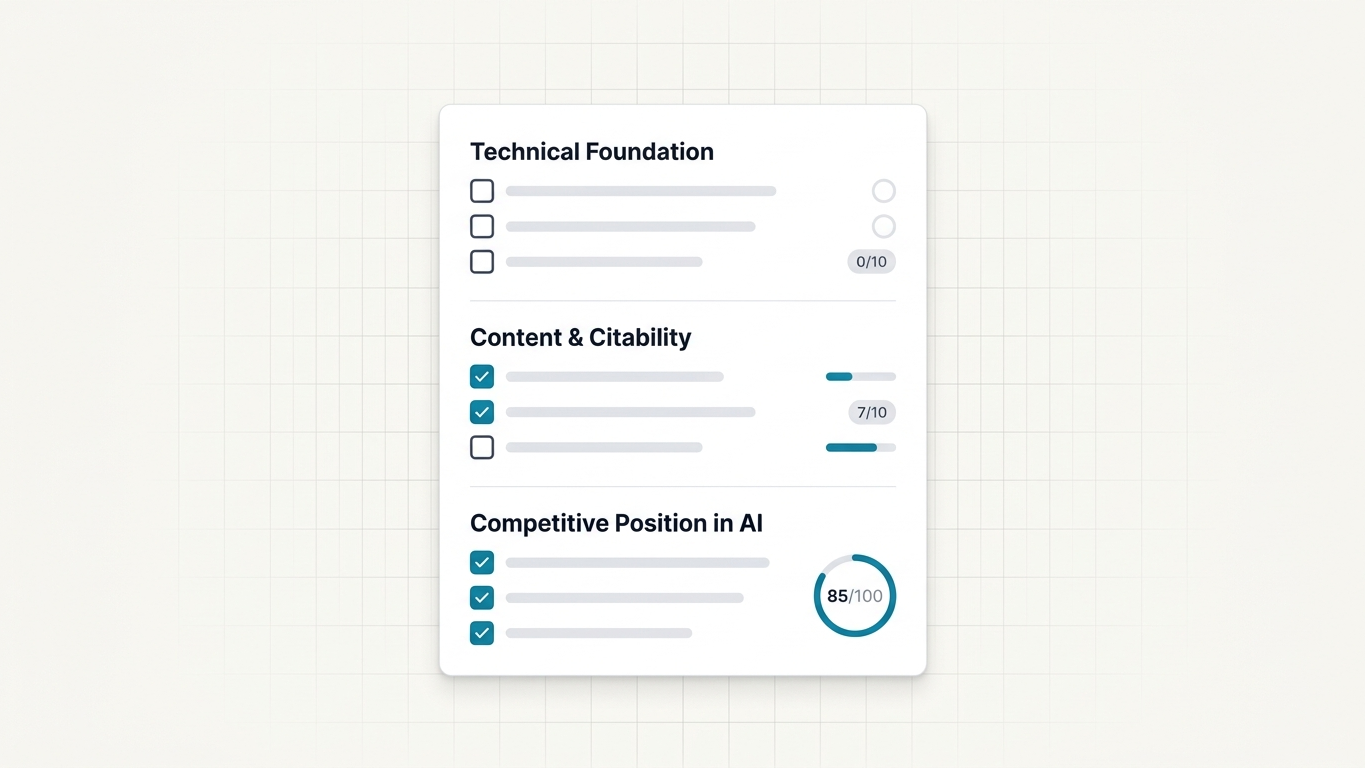
Traditional SEO tools measure search positions. But whether ChatGPT or Perplexity actually mentions your brand in an answer remains invisible without specific GEO measurement. The GEO Readiness Score quantifies exactly that: your visibility per AI platform, per query, per page.
For consultants, this is the proof you need. By tracking the score quarterly, you demonstrate the direct impact of your content strategy on AI citability. That transforms abstract advice into a measurable result.
The role of consistency and trend tracking
An entity is not built with a single blog post. AI models recognize patterns across hundreds of sources. Consistency in terminology, structure, and positioning is therefore essential.
Every time you formulate a term differently, you weaken the recognizability of your entity.
That is why GEO is not a one-time exercise. Quarterly trend tracking shows how your entities grow or lose ground in AI answers. For you as a consultant, this is the ultimate retention model: at each re-audit, you present the improvement of the GEO Score as a direct result of your strategy.
From keyword optimization to AI authority
The shift from keywords to entities is not a trend. It is the new infrastructure of digital visibility. Those who invest in an entity-based content strategy now are building a position that does not depend on a single algorithm update, but is anchored in the knowledge network of every AI engine.
Want to know if AI engines already recognize your brand as an entity? Start your audit today and receive your GEO Score with a concrete action plan within minutes. No account needed, no setup, instant results.
Do you have questions about implementation for your clients? Get in touch and discover how GrowthScope makes your consulting measurable.