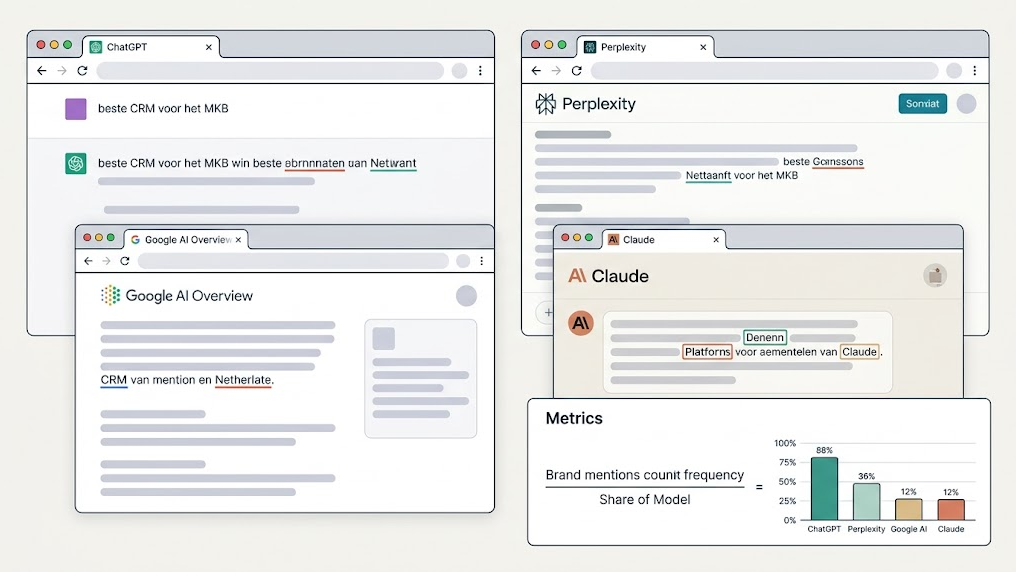
While you read this, ChatGPT is answering a question about your industry somewhere. The crucial question: is your brand mentioned, or your competitor's? AI visibility is no longer future talk. It's today's reality. The good news: you don't need to wait months for results. With these ten concrete actions, you'll improve your discoverability in AI engines before the end of the workday.
Why AI discoverability requires action now
AI engines like ChatGPT, Perplexity, Google AI Overviews and Claude generate answers based on sources they consider reliable and citable. That means the traditional SEO approach is no longer enough. You need a GEO strategy specifically aimed at how AI selects and presents your content.
The checklist below is structured from quick to strategic. The first five wins take you less than an hour. The last five anchor your advantage structurally.
Your checklist: 10 actions for direct AI visibility
1. Answer questions in the first paragraph
AI engines scan your pages for direct, concise answers. Make sure every important page starts with a clear core sentence that answers the visitor's main question. No three-paragraph introductions. Start with the answer, then support it.
2. Structure your content with clear headings
A logical heading structure (H1, H2, H3) helps AI crawlers understand the hierarchy of your information. Each heading should answer a specific sub-question. Think from the questions your customer asks, not from your internal department names.
3. Add schema markup to your key pages
Schema markup translates your website into a language AI understands. Start with the basics:
- FAQ schema on your most asked questions
- Organization schema with your company name, location and contact details
- Product or Service schema with prices and descriptions
This takes a developer less than an hour and directly increases your citability.
4. Create an llms.txt file
This relatively new file gives AI crawlers explicit instructions about your website. It's similar to robots.txt, but specifically for large language models. In your llms.txt you define which pages have priority and how AI should interpret your brand. A small file with major impact.
5. Check your robots.txt for AI crawlers
Many websites unknowingly block AI crawlers like GPTBot or ClaudeBot via their robots.txt. Check today whether your file allows these crawlers. One wrong rule can mean your entire website is invisible to AI engines.
6. Write for citability, not just readability
Citability is the degree to which AI can literally adopt your texts as a source. For that, use:
- Short, factual sentences with concrete figures
- Definition structures ("GEO is the optimization of...")
- Lists and tables that AI can easily extract
The easier your text is to cite, the more often AI engines will select you as a source.
7. Publish original data and perspectives
AI engines prefer unique sources over regurgitated information. Share your own research results, industry figures or a clear expert perspective. This increases your authority in the eyes of both AI and your target audience.
8. Optimize your "About us" and author pages
AI engines assess the credibility of a source partly based on the sender. Make sure your author pages are up to date, with name, title, expertise and any publications. A strong author page directly translates into higher E-E-A-T signals that AI factors into source selection.
9. Ensure consistent mention on external platforms
Your AI visibility doesn't just depend on your own website. AI engines train on and consult external sources. Check that your business information is consistent on:
- Google Business Profile
- Industry associations and directories
- Wikipedia, Wikidata and relevant knowledge bases
Inconsistent information leads to uncertainty in AI, and uncertainty means: not being mentioned.
10. Measure your starting position with a GEO audit
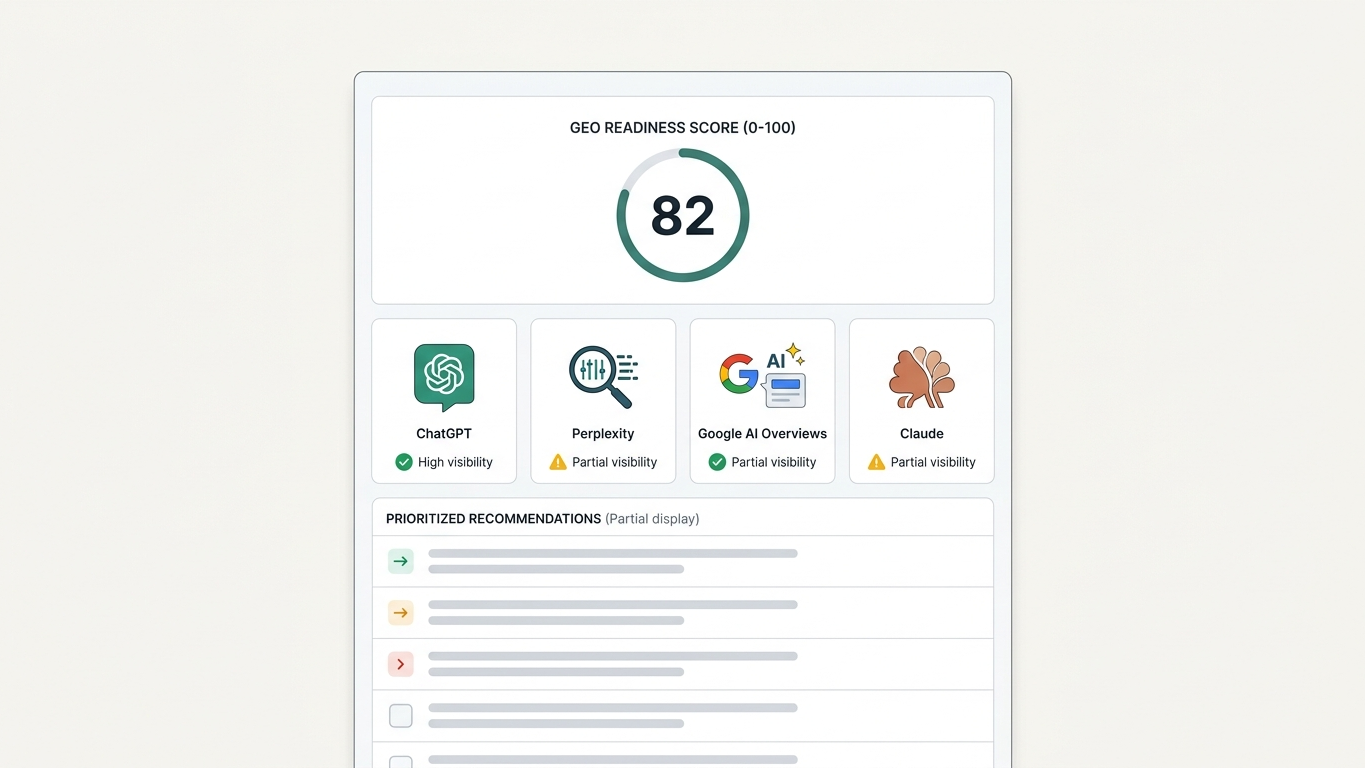
Without a baseline, you're optimizing blind. A GEO Readiness Score gives you a concrete figure from 0 to 100 that indicates how well your website currently performs in AI answers. You immediately see where you score and where the gaps are compared to your competitors.
Quick wins versus structural advantage
| Action | Time Investment | Impact on AI Visibility |
|---|---|---|
| Answer questions in first paragraph | 15 min per page | High |
| Improve heading structure | 30 min per page | High |
| Add schema markup | 1 hour (developer) | High |
| Create llms.txt | 30 minutes | Medium to high |
| Check robots.txt | 10 minutes | Critical (blocking risk) |
| Improve citability | 1 hour per page | High |
| Publish original data | Ongoing | Very high |
| Optimize author pages | 1 hour | Medium |
| Check external mentions | 2 hours | Medium |
| Perform GEO audit | 10 minutes | Fundamental (baseline) |
From checklist to continuous competitive advantage
GEO is not a one-time action, but an ongoing process of measuring, adjusting and measuring again.
These ten actions give you direct control over your AI visibility. But the AI market doesn't stand still. What works today can be outdated in three months by algorithm changes at ChatGPT, Perplexity or Google AI Overviews. That's why it's essential to continuously monitor and adjust.
Want to know exactly where you stand now? Start your GEO audit today and receive your personal action plan within 10 minutes. No account, no API keys, no setup. So tomorrow you'll know not only what you need to do, but also what your competitor is already doing.
Want to read more about how GEO differs from traditional SEO? Check out our detailed explanation of Generative Engine Optimization or contact us directly for personalized advice.