What is Generative Engine Optimization (GEO) and why does it determine your online visibility in 2026?
Generative Engine Optimization explained in plain language
Generative Engine Optimization (GEO) is the strategy that ensures AI systems like ChatGPT, Google Gemini and Perplexity actively recommend your business. While traditional SEO revolves around achieving a position in a list of search results, GEO revolves around the question: are you mentioned in the answer, or is your competitor?
If your brand does not appear in that generated answer, you simply do not exist for that potential customer.
More and more consumers are asking their purchase questions directly to an AI chatbot instead of scrolling through ten blue links. If your brand does not appear in that generated answer, you simply do not exist for that potential customer. GEO is the discipline that eliminates that risk.
Why traditional SEO alone is no longer sufficient
SEO has served you well over the past twenty years. You optimized pages, built backlinks and climbed the search results. But the playing field has fundamentally changed. AI search engines provide one summarizing answer instead of a page with options.
The result is binary: you get recommended, or you get skipped. There is no "position 4" anymore where you can still get some leftover traffic. Your competitor who does appear in that AI answer captures all the attention.
This does not mean SEO has become worthless. It means that SEO alone is no longer enough to protect your market position.
The difference between GEO and SEO at a glance
| Feature | Traditional SEO | Generative Engine Optimization (GEO) |
|---|---|---|
| Goal | Rank high on search results page | Be mentioned in AI-generated answers |
| Result | List of links for the user to choose from | One direct answer with possible source attribution |
| Competition | Top 10 positions available | Often only 1 to 3 recommendations per question |
| Content focus | Keywords and technical optimization | Authority, context and entity recognition |
| Measurability | Rankings, CTR, organic traffic | AI visibility, citation scores, prompt results |
| Speed of impact | Weeks to months | Can have immediate effect with proper positioning |
This overview makes one thing painfully clear: the rules have changed and those who continue playing by the old rulebook are losing ground.
How AI systems determine which business gets recommended
AI models generate their answers based on patterns in vast amounts of text. They look for sources that are consistent, structured and authoritative. Three factors carry significant weight:
- Consistency of information: is the same core message about your business repeated across multiple reliable sources?
- Entity recognition: does the AI model recognize your brand as a clearly defined entity with specific expertise?
- Contextual relevance: does your content align with the way users formulate their questions to a chatbot?
With more than 20 years of experience in online visibility, we have seen this shift coming up close. From our office in Schijndel, our own experts work daily on strategies that precisely leverage these three pillars.
Five concrete steps to get started with GEO
You don't have to wait months for results. With the right approach, you can start today. These are the steps we recommend:
- Scan your current AI visibility: enter your key customer questions into ChatGPT and note whether you are mentioned
- Map your competitors: who is getting recommended and why?
- Optimize your entity profile: ensure your business information is consistent across all platforms
- Create answer-worthy content: write content that directly answers specific customer questions
- Measure and iterate: monitor weekly whether your position in AI answers improves
Why speed matters here
The market for AI visibility is still young. That means companies investing in GEO now are building a lead that will be hard to catch up with later. Compare it to the early days of Google: those who applied SEO back then dominated search results for years.
What it costs you if you are not visible in AI answers
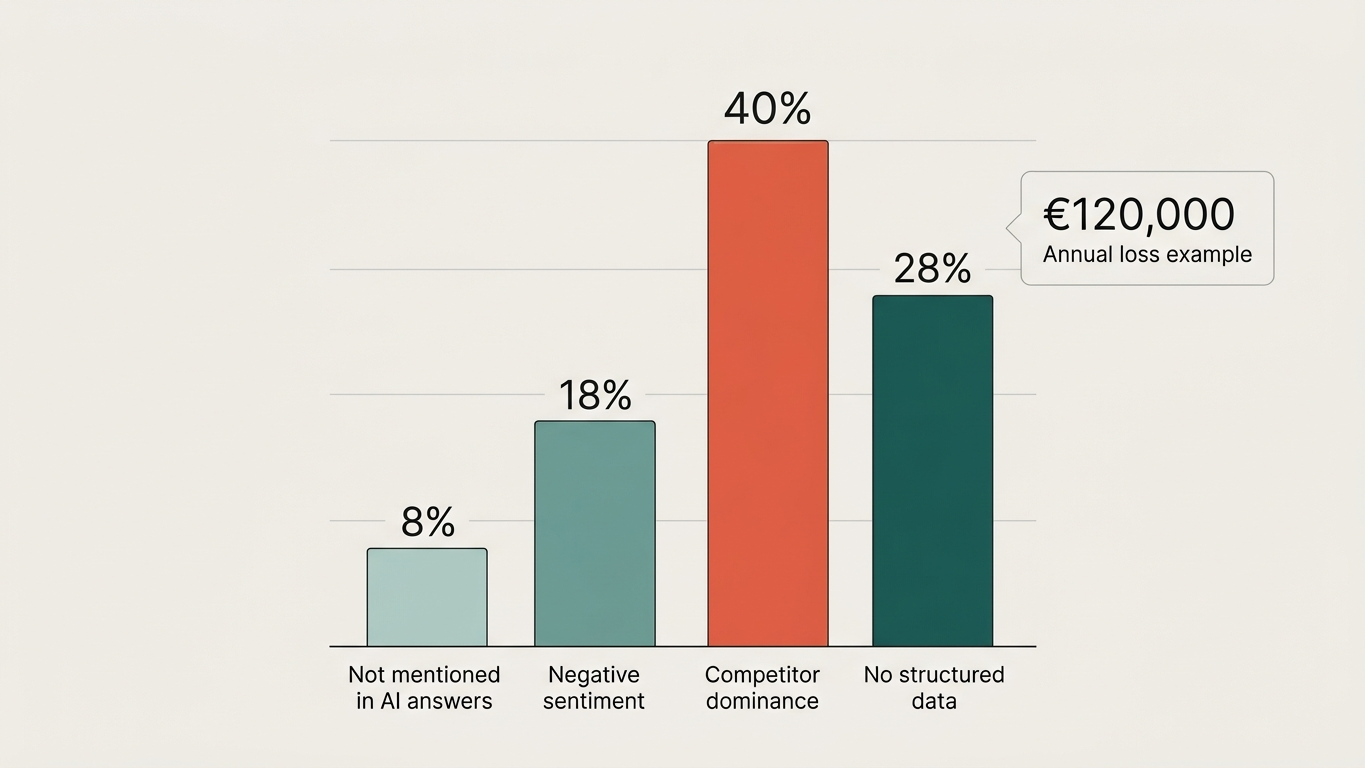
Let's be specific. Suppose 30% of your potential customers now use an AI chatbot to find suppliers. If your competitor consistently gets recommended there and you don't, you are not losing a ranking, you are losing revenue.
If your competitor consistently gets recommended there and you don't, you are not losing a ranking, you are losing revenue.
This is not about theoretical risk. This is about customers who right now, today, are asking a purchase question to ChatGPT and getting an answer that does not include your business name.
Combining GEO and SEO for maximum results
The smartest strategy is not to choose between GEO and SEO, but to combine both disciplines. Your SEO foundation ensures that search engines index your content and consider it trustworthy. Your GEO strategy ensures that AI models use that same content in their answers. Consider implementing llms.txt on your website to further enhance AI visibility.
The result is dual visibility: you score in traditional search results and you get recommended by AI assistants. That is not a luxury anymore, that is the new standard for entrepreneurs who want to stay relevant.
The next step: know where you stand before you invest
Before you allocate budget for GEO, you want to know where you stand now. A competitive scan shows within 15 minutes where you are leaving revenue on the table in AI answers. You get a comparison chart, a gap analysis and a prioritized action plan.
No account needed, no technical knowledge required. Just direct insights you can act on today. Because in the world of Generative Engine Optimization, one rule applies: whoever moves first, wins. Visit our pricing page to see our scan options, or check our frequently asked questions for more details.