Content clustering for maximum LLM recognition: how to become the source AI chooses
AI engines like ChatGPT, Perplexity and Google AI Overviews don't just cite random pages. They search for websites that treat a topic broadly and deeply. Without clear content structure, your brand misses alignment with how large language models (LLMs) select and present information. Content clustering is the method by which you transform your website into an authority source that AI cannot ignore.
In this tutorial, you'll learn step by step how to build content clusters specifically designed for maximum LLM recognition.
Why content clustering is essential for AI visibility
Traditional SEO revolved around individual pages that each ranked for one keyword. LLMs work fundamentally differently. They assess the coherence between pages to determine whether a website truly has expertise on a topic.
A single blog article about "GEO" won't convince an AI model. But a cluster of interconnected pages about generative engine optimization, technical implementation, and measurable results will. That pattern signals topical authority.
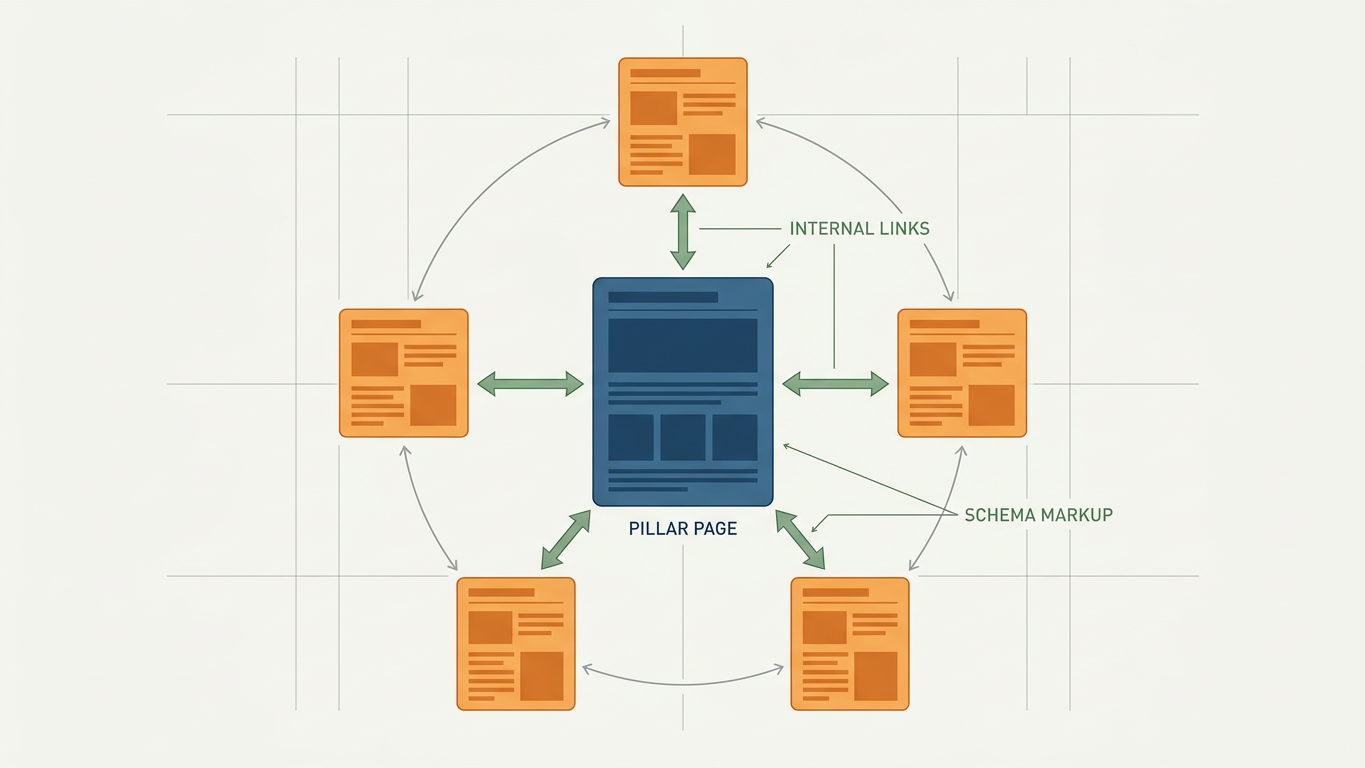
Content clustering groups your content around core topics. Each cluster consists of a pillar page (the main page) and multiple supporting articles that dive deeper into subtopics. The internal links form a web of context that helps LLMs select your brand as the primary source.
Step 1: define your core topics from AI queries
Don't start with keywords, but with the questions users ask AI. This is a fundamental shift. AI queries are conversational and often broader than traditional searches.
Here's how to map your core topics:
- Identify the three to five themes your organization has the most expertise in.
- Formulate at least ten questions per theme that a user would ask ChatGPT or Perplexity.
- Group those questions around subtopics that together cover the full theme.
A GEO audit immediately shows which queries AI already mention you on and where the gaps are. Those gaps are your opportunities for new cluster content.
Step 2: design the cluster structure
Each cluster follows a fixed architecture. The pillar page covers the core topic broadly. The supporting pages dive deep into specific sub-questions.
| Element | Function | Example |
|---|---|---|
| Pillar page | Broad overview of the core topic | "What is GEO?" |
| Cluster page | In-depth coverage of one sub-question | "What is llms.txt?" |
| Internal link | Connects cluster and confirms coherence | Link from pillar to cluster page and vice versa |
| Schema markup | Translates structure into machine-readable language | FAQ schema, Article schema |
The pillar page links to each cluster page. Each cluster page links back to the pillar. This creates a closed information network that LLMs recognize as a coherent knowledge source.
Practical example: a cluster around llms.txt
Suppose you want to build authority around the topic llms.txt. Your cluster would look like this:
- Pillar page: Everything about llms.txt and AI crawlers
- Cluster page 1: How to create an llms.txt file
- Cluster page 2: The difference between robots.txt and llms.txt
- Cluster page 3: Which AI crawlers support llms.txt
- Cluster page 4: Common mistakes in llms.txt implementation
Each page answers a specific question an AI engine might receive. Together they prove that your website completely masters the topic.
Step 3: optimize each page for citeability
LLMs look for text they can directly adopt as an answer.
Make each page citable with these principles:
- Start each paragraph with the conclusion. AI engines scan the first sentence of a paragraph as a potential quote.
- Use definitions and direct answers. Formulate sentences like: "Content clustering is the method by which..." instead of vague introductions.
- Add structured data. Schema markup translates your text into a language AI understands. Think FAQ schema, HowTo schema, and Article schema.
- Keep paragraphs short. Maximum three to four sentences per paragraph increases the chance that an LLM selects a coherent fragment.
Step 4: measure and improve your cluster performance
AI answers are a zero-sum game. If your competitor is the source, you're not.
Content clustering is not a one-time action. It's a continuous process of measuring, adjusting and expanding. The question isn't just whether AI mentions you, but how and in what context.
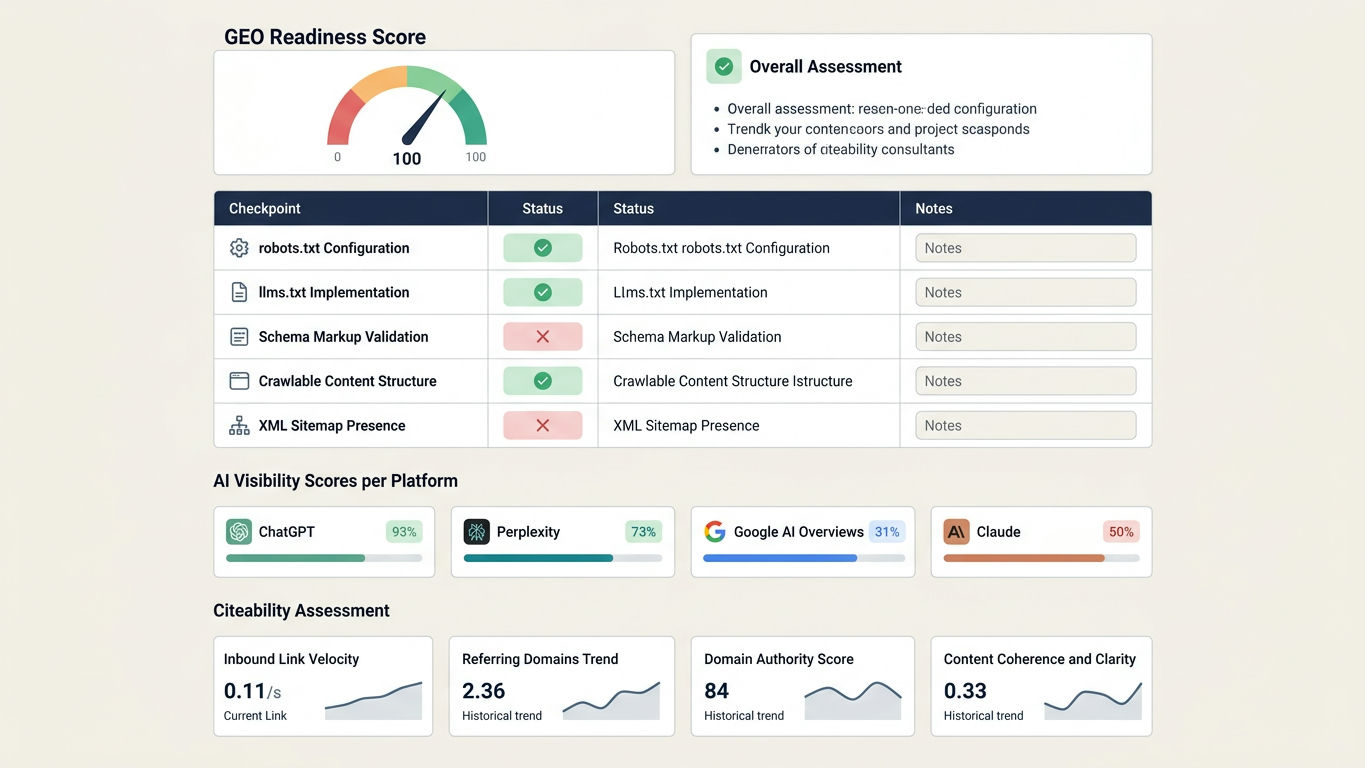
With a GEO Readiness Score, you measure per page how well your content scores on the criteria LLMs use. The score from 0 to 100 gives you a clear starting point. By tracking quarterly reports through trend tracking, you see exactly which clusters are gaining strength and which need adjustment.
Check the following points each quarter:
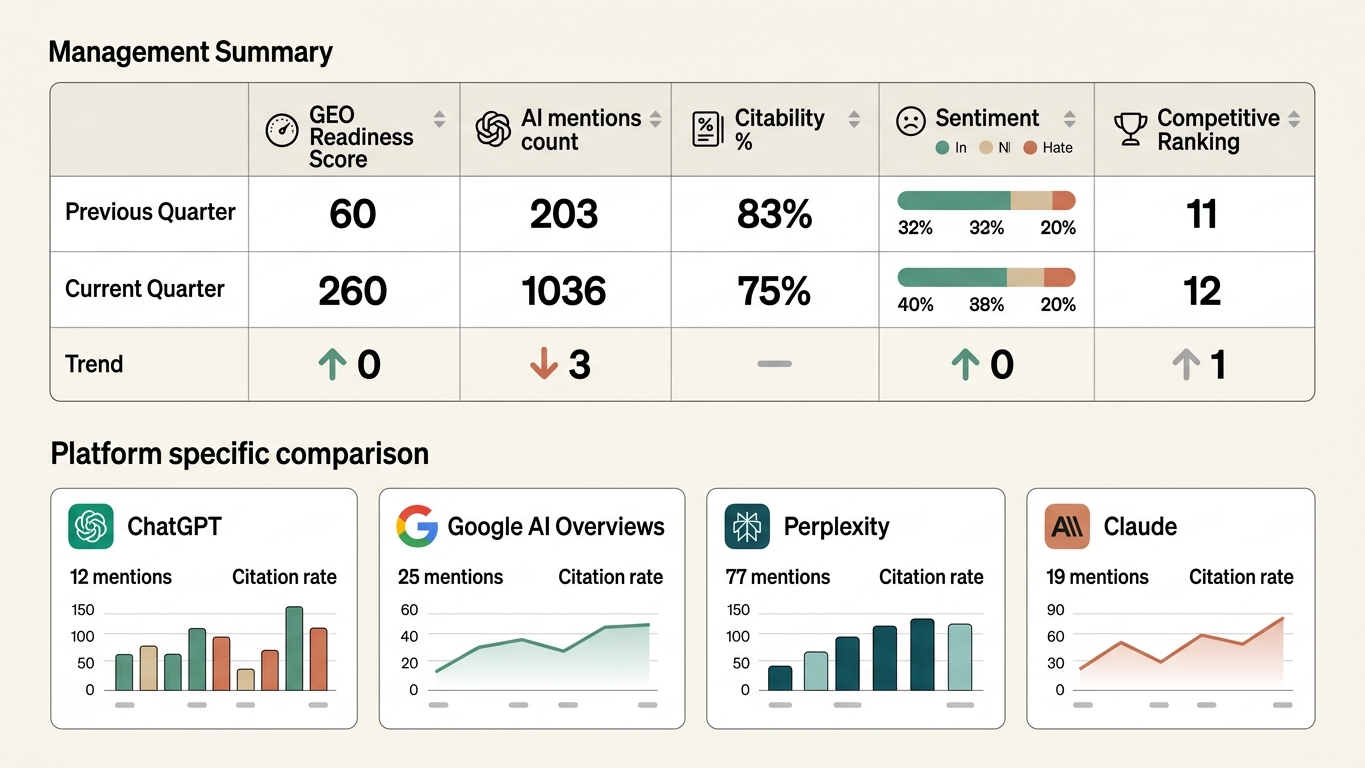
- Which queries is your pillar page cited for by ChatGPT, Perplexity, Google AI Overviews and Claude?
- Which cluster pages are most often selected as sources?
- Where do AI engines mention your competitor instead of you?
Start your first content cluster today
Content clustering for LLM recognition requires a methodical approach: define core topics, build a clear cluster structure, make pages citable, and measure continuously. The difference between being found by AI and remaining invisible lies in that structure.
Want to know how AI engines assess your current content? Start your audit and receive your GEO Score within minutes with immediately applicable recommendations. No account needed, no setup, no API keys.
Have questions about your GEO strategy? Get in touch and discover how to take your content clusters to the next level.