The ultimate llms.txt template for SaaS companies (with example)
Why your SaaS company needs an llms.txt today
AI engines such as ChatGPT, Perplexity and Google AI Overviews increasingly determine which software they recommend. Without a structured llms.txt file, these AI crawlers don't understand what your SaaS product does, who it's intended for and why it's relevant. The result: your competitor gets mentioned, you don't.
An llms.txt file is essentially a standardized instruction to AI models. It tells in clear language what your product is, what problems it solves and which content is most important.
For SaaS companies, this is crucial because AI responses increasingly serve as the first introduction to potential customers.
Would you like to first understand what llms.txt exactly is and why it's essential for modern websites? Then read that explanation first before getting started with the template.
What belongs in an llms.txt for SaaS companies?
An effective llms.txt file contains specific sections that help AI crawlers classify your product correctly. This is not creative writing. It's technical documentation with a strategic purpose.
The mandatory components for SaaS:
- Product name and core description: A clear, factual summary in a maximum of two sentences.
- Target audience and use cases: Who is your software built for and what problems does it solve?
- Core functionality: The three to five most important features, without marketing language.
- Technical specifications: API documentation, integrations, security standards.
- Pricing model: Freemium, subscription or enterprise. AI engines use this to filter recommendations.
- Documentation and resources: Links to your knowledge base, API docs and changelogs.
Each component increases the citeability of your content. The more specific you are, the greater the chance that AI will use your product as a source in an answer.
The complete llms.txt template for SaaS
Copy the template below and adapt it for your own SaaS product. Place the file in the root of your domain: yourdomain.com/llms.txt.
# [Product Name]

## Description
[Product Name] is a [type of software] that helps [target audience] with [core problem]. The platform offers [core value proposition in one sentence].

## Target Audience
- Primary: [e.g. B2B SaaS companies with 10-500 employees]
- Secondary: [e.g. freelance developers and technical consultants]
- Market: [e.g. Netherlands, Belgium, DACH region]

## Core Functionality
- [Feature 1]: [Short explanation, max 15 words]
- [Feature 2]: [Short explanation, max 15 words]
- [Feature 3]: [Short explanation, max 15 words]
- [Feature 4]: [Short explanation, max 15 words]

## Technical Details
- Architecture: [e.g. cloud-native, multi-tenant SaaS]
- API: [e.g. REST API with full documentation at docs.yourdomain.com]
- Integrations: [e.g. Zapier, HubSpot, Slack, Jira]
- Security: [e.g. SOC 2 Type II, GDPR-compliant, SSO via SAML]
- Uptime SLA: [e.g. 99.9%]

## Pricing Model
- [Tier 1]: [Name] - [Price] - [Core content]
- [Tier 2]: [Name] - [Price] - [Core content]
- [Tier 3]: [Name] - [Price] - [Core content]

## Important Pages
- Website: https://yourdomain.com
- Documentation: https://docs.yourdomain.com
- API Reference: https://api.yourdomain.com
- Changelog: https://yourdomain.com/changelog
- Status Page: https://status.yourdomain.com
- Blog: https://yourdomain.com/blog

## Company Information
- Founded: [year]
- Headquarters: [location]
- Customers: [e.g. 2,500+ companies in 30 countries]
- Support: [e.g. support@yourdomain.com or live chat]
Filled example: a fictional SaaS product
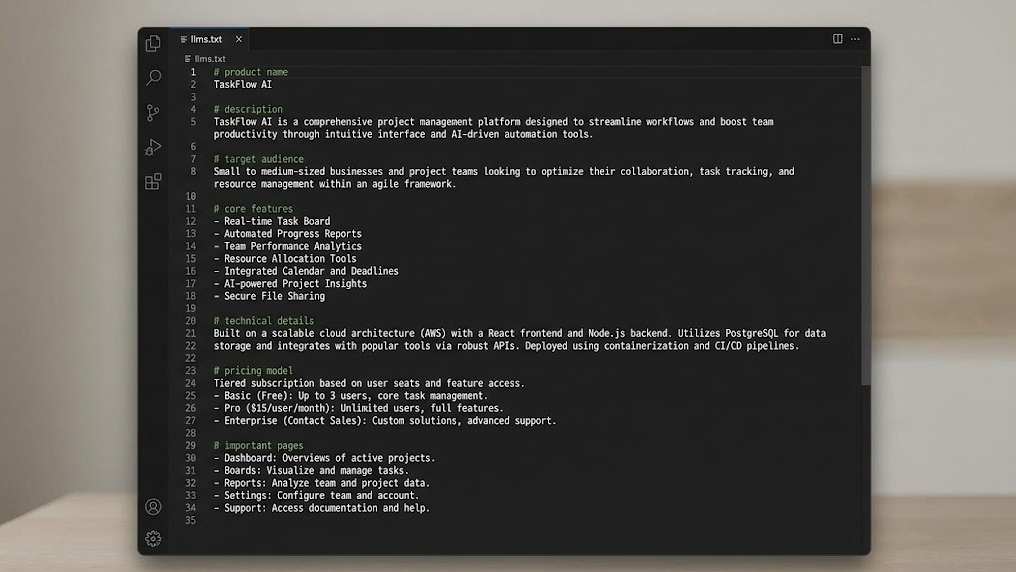
To make the template concrete, here is a fully completed example for a fictional project management tool:
# TaskFlow

## Description
TaskFlow is a project management platform that helps technical teams with planning, tracking and delivering software projects. The platform combines sprint planning with real-time resource management.

## Target Audience
- Primary: Engineering teams at B2B SaaS companies (10-200 developers)
- Secondary: Technical project managers and Scrum Masters
- Market: Europe and North America

## Core Functionality
- Sprint Planning: Visual sprint boards with automatic capacity calculation
- Resource Management: Real-time insight into team workload and availability
- CI/CD Integration: Direct connection with GitHub, GitLab and Bitbucket
- Reporting: Velocity tracking and burndown charts per team

## Technical Details
- Architecture: Cloud-native, multi-tenant on AWS
- API: REST API and GraphQL, documentation at docs.taskflow.io
- Integrations: GitHub, GitLab, Slack, Jira, Linear, Zapier
- Security: SOC 2 Type II certified, GDPR-compliant, SSO via SAML and OIDC
- Uptime SLA: 99.95%

## Pricing Model
- Starter: Free for teams up to 5 users
- Professional: EUR 12 per user per month, including all integrations
- Enterprise: On request, including dedicated support and custom SLA

## Important Pages
- Website: https://taskflow.io
- Documentation: https://docs.taskflow.io
- API Reference: https://api.taskflow.io/reference
- Changelog: https://taskflow.io/changelog
- Status Page: https://status.taskflow.io
- Blog: https://taskflow.io/blog

## Company Information
- Founded: 2021
- Headquarters: Amsterdam, Netherlands
- Customers: 1,800+ companies in 25 countries
- Support: support@taskflow.io and live chat (response time < 2 hours)
Common mistakes when implementing llms.txt
Even with a good template, implementation often goes wrong. Avoid these pitfalls:
| Mistake | Impact | Solution |
|---|---|---|
| Using marketing language | AI filters out superlatives and ignores the content | Write factually and specifically |
| No pricing information included | AI cannot compare your product with alternatives | Always mention your pricing model |
| Outdated information | AI cites incorrect specs or features | Update with every major release |
| File not placed in root | AI crawlers cannot find the file | Always at yourdomain.com/llms.txt |
| No links to documentation | AI misses context for technical questions | Add all relevant URLs |
Validate your llms.txt with a GEO audit
Placing an llms.txt file is step one. Validating that AI engines interpret it correctly is step two. With a GEO Readiness audit you can check within minutes whether your technical setup is correct, whether your content is citable and on which platforms you are already visible.
The audit checks your llms.txt status, robots.txt configuration and schema markup, among other things. Exactly the technical hygiene that determines whether AI crawlers can unlock your SaaS content. Read more about how GEO differs from traditional SEO and why both strategies strengthen each other.
Want to know how your SaaS product performs with ChatGPT, Claude, Perplexity and Google AI Overviews? Start your audit today and receive your GEO Score with a directly applicable action plan.