Stakeholder Management During GEO Transition: How to Bring Your Entire Team On Board
Why Stakeholder Management is Essential for Your GEO Transition
The transition to Generative Engine Optimization is not a marketing project. It is an organization-wide shift that impacts content, technology, brand strategy and budget allocation. Without buy-in from your stakeholders, even the best GEO strategy will stall at the first boardroom question.
The problem is recognizable. You see that AI engines such as ChatGPT, Perplexity and Google AI Overviews increasingly become the first point of contact for your target audience. But your CEO asks for proof, your developer wants to know what changes technically and your sales team doesn't understand why "Google rankings" are no longer enough. Stakeholder management is the bridge between your GEO strategy and actual implementation.
The Three Stakeholder Groups You Must Convince
Not every stakeholder needs the same language. The key to successful GEO adoption lies in segmenting your internal audience and tailoring your message to their specific interests.
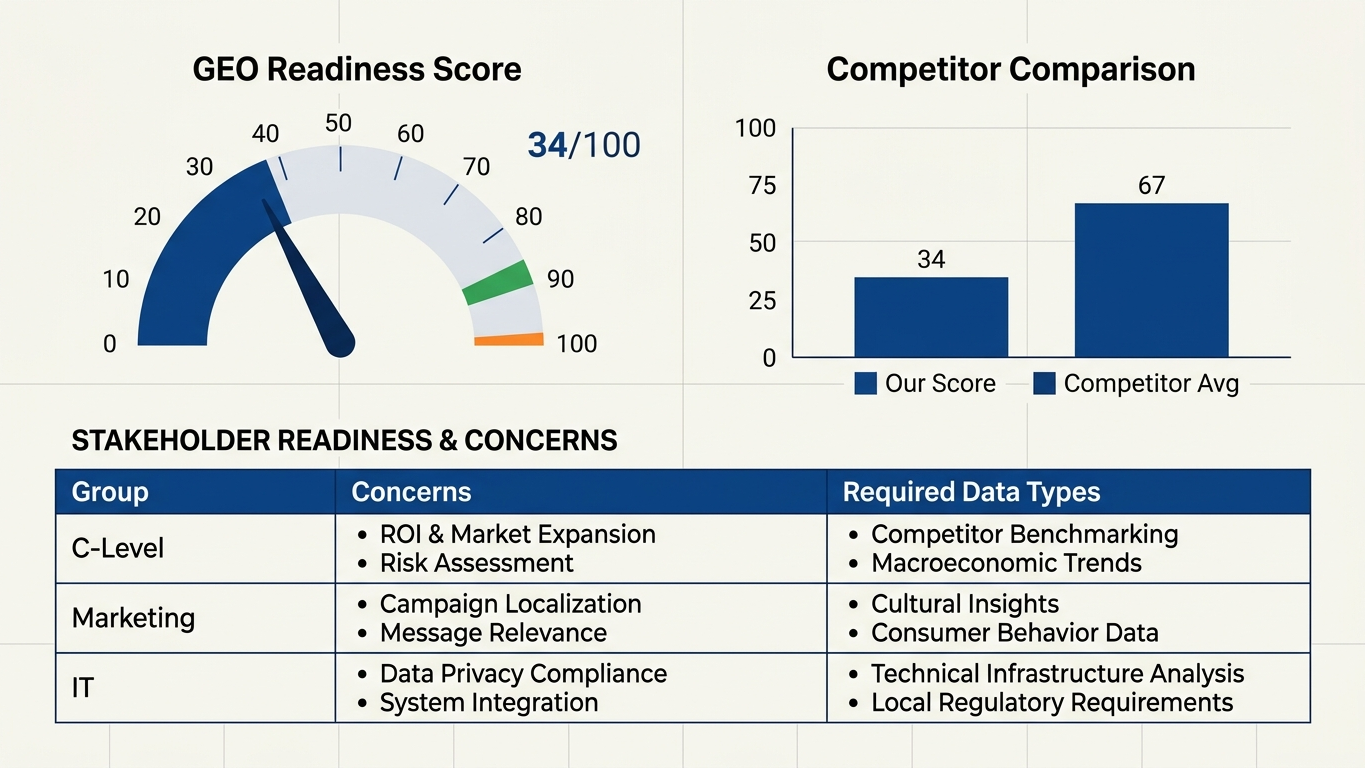
| Stakeholder Group | Primary Concern | What They Need |
|---|---|---|
| C-level / Management | ROI and strategic risk | A quantifiable metric such as the GEO Score (0-100) |
| Marketing and content | Visibility and competitive position | Platform-specific data per AI engine |
| IT and development | Technical feasibility and workload | Concrete implementation steps such as llms.txt and schema markup |
By addressing each group on their own pain point, you prevent the transition from getting bogged down in abstract discussions about "the future of AI."
Step 1: Create Urgency With Data, Not Opinions
Management and budget holders don't respond to trends. They respond to figures that expose a risk or missed opportunity. Your first step, therefore, is to translate the GEO transition into a concrete business case.
Start with a GEO audit of your own domain. The GEO Readiness Score gives you an objective starting point within minutes. Compare this with the scores of your direct competitors via a Competitive Analysis. Nothing creates more urgency than the realization that a competitor is being recommended by AI.
Present this data at your next management meeting as follows:
- The current situation: "Our GEO Score is 34/100. Competitor X scores 67/100."
- The risk: "In 40% of our industry-relevant queries, our brand is not mentioned by ChatGPT or Google AI."
- The solution: "With targeted optimization, we can increase our citability within a quarter."
This approach transforms a vague AI story into a measurable improvement trajectory.
Step 2: Give Each Team Its Own Role in the Action Plan
GEO implementation affects multiple departments. When you break down the action plan into clear responsibilities, you reduce resistance and increase ownership.
For Your Content Team
Your content team must understand that citability is the new metric. AI engines only cite texts that are clear, structured and factual. Ask your content manager to evaluate existing pages for direct answers, clear definitions and logical heading structure.
For Your Technical Team
Developers want to know what concretely changes. The technical GEO setup includes implementing llms.txt, optimizing schema markup and checking robots.txt settings. These tasks are well-defined and fit into a regular sprint.
For Your Management
Management receives the Management Summary from the In-Depth Scan. This summary contains expected impact scores and directly applicable recommendations, translated into strategic priorities. No technical jargon, but business impact.
Step 3: Make Progress Visible With Quarterly Reports
Stakeholders disengage when results remain invisible. GEO is not a one-time action. It is a continuous process of measuring, adjusting and measuring again. This is precisely why trend tracking is essential.
Schedule quarterly reports in which you present the progress of your GEO Score. Show which AI platforms your visibility has increased on and where adjustments are needed. By presenting results per platform (ChatGPT, Claude, Perplexity, Google AI Overviews) you give each team member the data that is relevant to them.
This cadence has three advantages:
- Accountability: Each team sees the impact of their efforts.
- Budget justification: You demonstrate progress to your management with hard numbers.
- Competitive insight: You detect market shifts before they become a problem.
The Pitfalls You Must Avoid
Stakeholder management in GEO has specific risks. The biggest danger is that you present GEO as "something for marketing."
Once it is seen as a silo project, you lose the support of IT and management.
Additionally, avoid these common mistakes:
- Not measuring a baseline. Without a starting score, you cannot demonstrate progress. Always start with an audit.
- Communicating too technically to management. Talk about brand visibility and competitive position, not crawlers and markup.
- Reporting only once. A single scan shows a snapshot. Only trend tracking proves structural growth.
Start Today With Your First Stakeholder Conversation
The transition to GEO doesn't start with technology. It starts with buy-in. Use the GEO Readiness Score as your central metric, segment your message per stakeholder group and make results visible with quarterly reports.
Your first step is concrete: start a GEO audit and present the results in your next meeting. No account needed, no setup, no API keys. Within 10 minutes you have the data to convince your stakeholders.
Do you have questions about the right approach for your organization? Get in touch via support@growthscope.io. We'd be happy to think through your GEO strategy with you.