Per-page query mapping: which questions do you direct to which page?
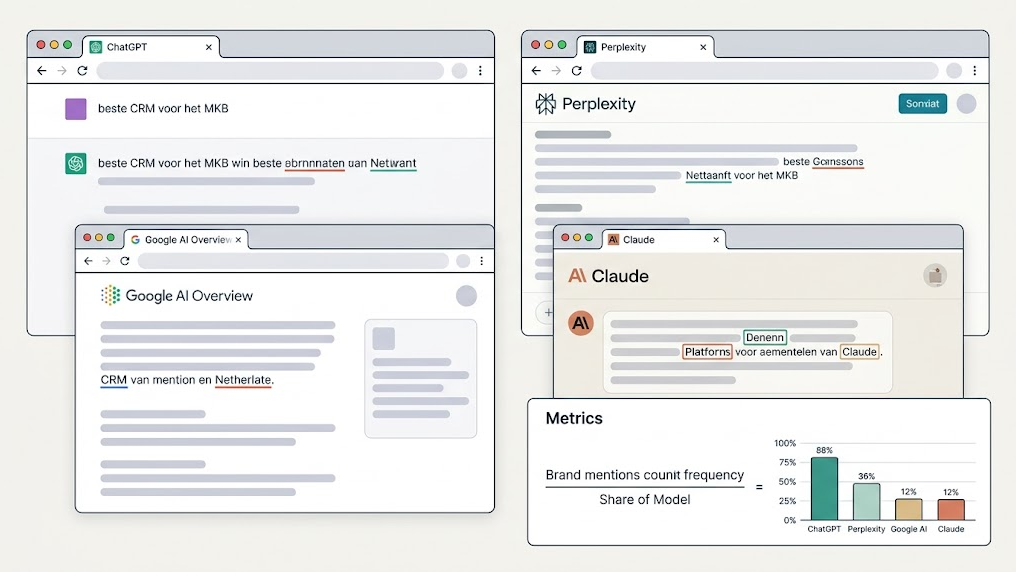
AI engines like ChatGPT, Perplexity and Google AI Overviews don't just pick a source at random. They select the page that best matches a specific question. Per-page query mapping is the strategy by which you determine which page answers which question.
Without that connection, you waste authority and leave AI visibility on the table.
Why per-page query mapping is essential for AI visibility
Traditional SEO was about assigning keywords to pages. With Generative Engine Optimization (GEO) it goes a step further. AI engines answer complete questions and cite the source that is most relevant and structured.
Suppose three pages on your website all partially answer the same question. The AI engine can't decide and skips your domain. Per-page query mapping prevents that internal competition and ensures each page has a clear, defined purpose.
The result: higher citability, a better GEO Score and more mentions in AI answers.
Step 1: map your existing pages
Start with an inventory. You can only assign queries once you know which pages you have and what their current function is. Create an overview with the following columns:
| Column | What you note |
|---|---|
| URL | The full address of the page |
| Current topic | The core message in a maximum of five words |
| Page type | Blog, product page, FAQ, landing page |
| Target audience | Decision maker, developer or marketer |
This overview is your starting point. Mark pages that overlap in topic, as those carry the greatest risks for AI confusion.
Step 2: identify the questions AI engines ask
AI users don't enter isolated search terms. They formulate complete questions. Think of "What is the difference between SEO and GEO?" or "How do I make my website visible in ChatGPT?"
Gather relevant queries in three ways:
- Your own expertise: What questions do you get daily from customers?
- AI platforms: Type your industry into ChatGPT or Perplexity and note the follow-up questions that are suggested.
- GEO audit: Use a GrowthScope scan to discover which industry-relevant queries AI engines are already connecting to your competitors.
Sort the collected questions by theme. Each cluster of questions will later belong to exactly one page.
Step 3: link each query to one page
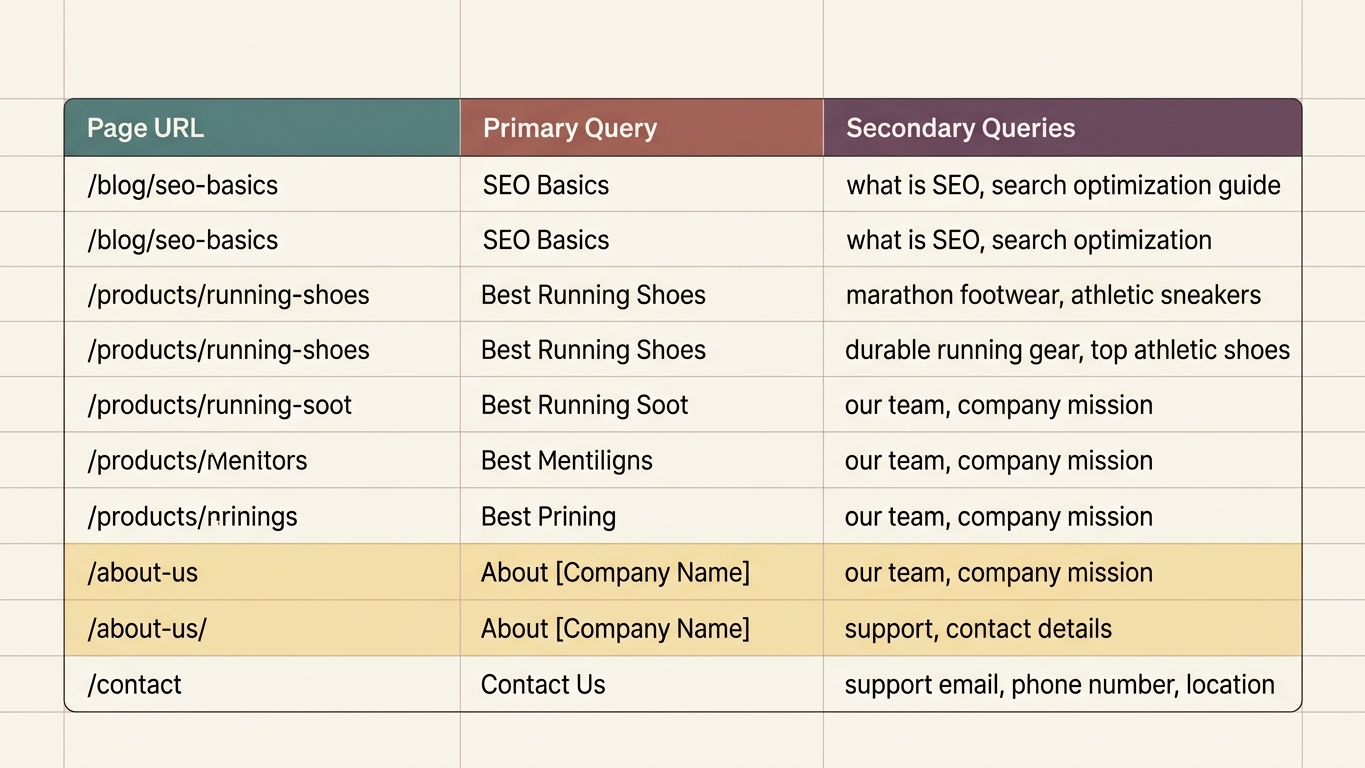
This is the core of per-page query mapping. Assign each question to the page that can best answer it. Follow three rules:
- One primary query per page. This is the question the page answers most completely.
- A maximum of three secondary queries per page. These questions tie directly to the main topic.
- No overlap. Does a query qualify for two pages? Choose the page with the most topical authority or combine the content.
Example of a query mapping
| Page | Primary query | Secondary queries |
|---|---|---|
| /blog/what-is-geo | What is Generative Engine Optimization? | Difference between SEO and GEO, Why is GEO important |
| /blog/llms-txt | What is llms.txt? | How do I create an llms.txt, Difference between llms.txt and robots.txt |
| /services/audit | How do I measure my AI visibility? | GEO Score explained, AI audit costs |
Through this assignment, you know exactly which page to optimize for which question. No double work, no cannibalization.
Step 4: optimize each page for citability
Now that the mapping is in place, you optimize each page so that AI engines can easily extract the answer. Citability revolves around structure and clarity.
Apply the following elements to each assigned page:
- Answer the primary query in the first paragraph. AI engines scan the opening first.
- Use schema markup. This translates your content into a language AI understands. Think FAQ schema or HowTo schema.
- Add an llms.txt file. This gives AI crawlers explicit instructions about which pages they are allowed to index.
- Write in short, factual paragraphs. A maximum of three to four sentences per paragraph. Exactly as you're reading now.
Step 5: measure results and adjust
Per-page query mapping is not a one-time action. AI models are continuously updated and new competitors emerge.
So measure regularly whether your pages are actually being cited.
A GrowthScope In-depth Scan analyzes 25 industry-relevant queries across ChatGPT, Perplexity, Google AI Overviews and Claude. You see per page whether your mapping works and where competitors are overtaking you.
With the quarterly subscription, you automate this trend tracking. With each re-audit, you present the improvement in GEO Score as a direct result of your strategy. That's measurable proof for your clients.
Checklist: per-page query mapping in five steps
- Inventory all existing pages and their current function
- Collect AI-relevant queries via customer questions, AI platforms and a GEO audit
- Assign each query to exactly one page without overlap
- Optimize each page for citability with schema markup and llms.txt
- Measure quarterly results and adjust your mapping based on AI data
Start your query mapping today
The first step is knowing where you stand. Start your GEO audit and discover which queries AI engines are already linking to your domain. No account, no setup. Results within 10 minutes.
Get control of which AI mentions you and why. Make sure each page answers exactly the question it's meant for.
Get in touch if you need help setting up your query mapping strategy.