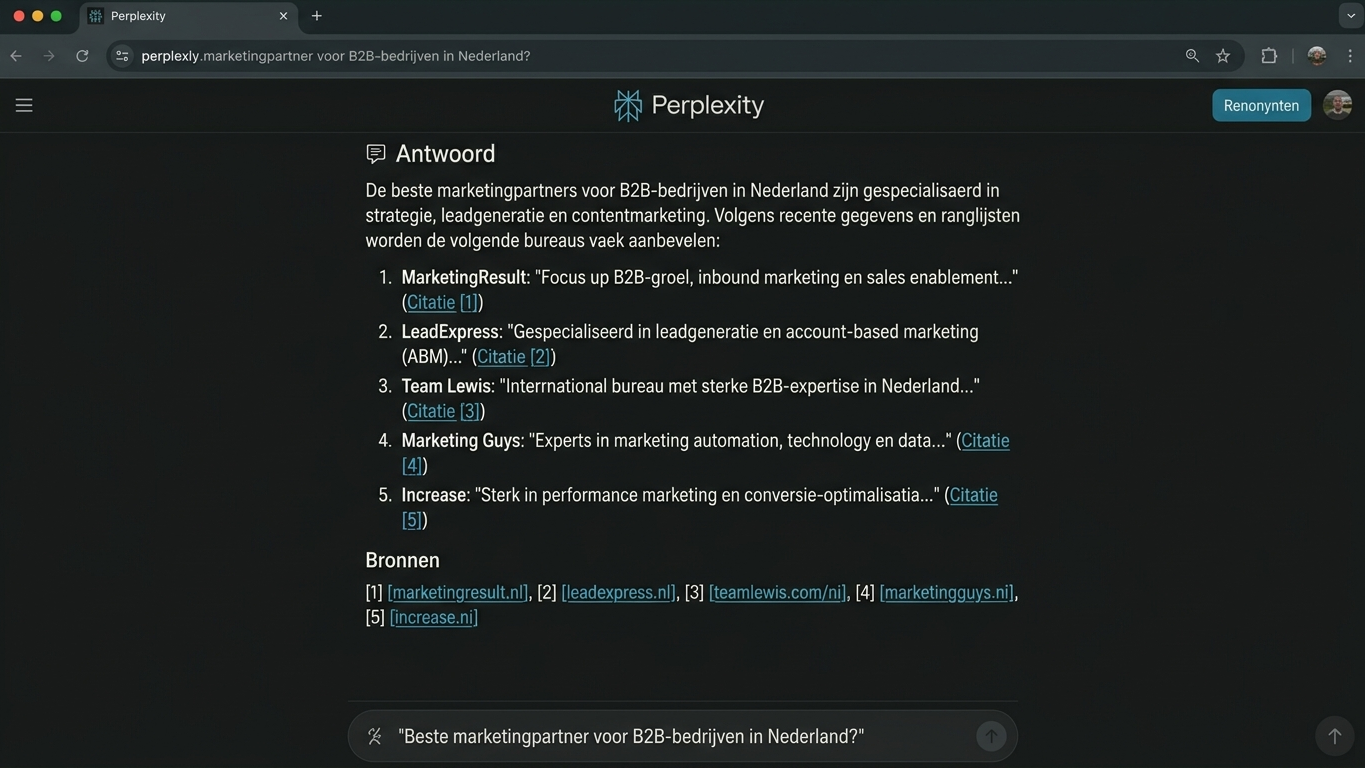
Suppose a potential customer asks ChatGPT: "What is the best marketing partner for B2B companies in the Netherlands?" Do you know if your brand appears in that answer? This is the core question of Generative Engine Optimization (GEO). And you only find the answer by testing with the questions your target audience actually asks.
The only way to know how AI engines report about your brand is by running live queries that precisely align with your industry, your services, and your competitive landscape.
The problem with generic AI analyses
Many organizations base their GEO strategy on assumptions. They check if their website is technically sound, optimize their schema markup, and hope that AI models will pick them up automatically. But technical readiness is only half the story.
AI models like ChatGPT, Perplexity, Google AI Overviews, and Claude generate answers based on context, relevance, and authority. Each model weighs sources differently. A generic analysis might tell you your site is "crawlable," but not whether you're actually mentioned when someone asks a purchase-intent question.
The difference is crucial: technical visibility does not mean you are citable. And citability is exactly what determines whether your brand appears in the AI answer.
What are live LLM-queries and why are they essential?
Live LLM-queries are real-time test questions asked directly to AI platforms to measure whether, where, and how your brand is mentioned. It's not about simulations or estimates. It's about hard data from the models your customers consult every day.
The power lies in the industry relevance of those questions. An accounting firm should test with questions like "Best accountant for startups in Utrecht," not generic prompts about bookkeeping. A software company wants to know what appears for "Best CRM system for SMBs in the Netherlands."
Industry-relevant queries provide you with three essential insights:
- Visibility per platform. Are you mentioned in ChatGPT but not in Perplexity? That difference determines where you need to adjust.
- Competitive position. Which competitor is recommended and why? AI answers are a zero-sum game: if your competitor is in there, you probably aren't.
- Sentiment analysis. Not just whether you're mentioned, but how. Positive, neutral, or negative? This directly affects your brand reputation.
From data to action: how industry-relevant queries drive your strategy
The value of live queries lies not only in measurement. Real returns emerge when you translate results into concrete optimizations. This is where the difference between a superficial scan and an in-depth audit becomes clear.
| Analysis approach | What you know | What you miss |
|---|---|---|
| Generic technical scan | Whether your site is crawlable | Whether you're actually cited |
| Quick scan (3 queries) | Initial indication of visibility | Statistically supported patterns |
| In-depth scan (25 queries) | Complete visibility score per platform | Nothing: this is your complete baseline |
With 25 industry-relevant queries across four platforms, you get the statistical significance needed for informed decision-making. The GEO Readiness Score quantifies your starting position on a scale of 0 to 100. This means you report not in vague terms, but with a concrete metric stakeholders immediately understand.
The role of technical foundations
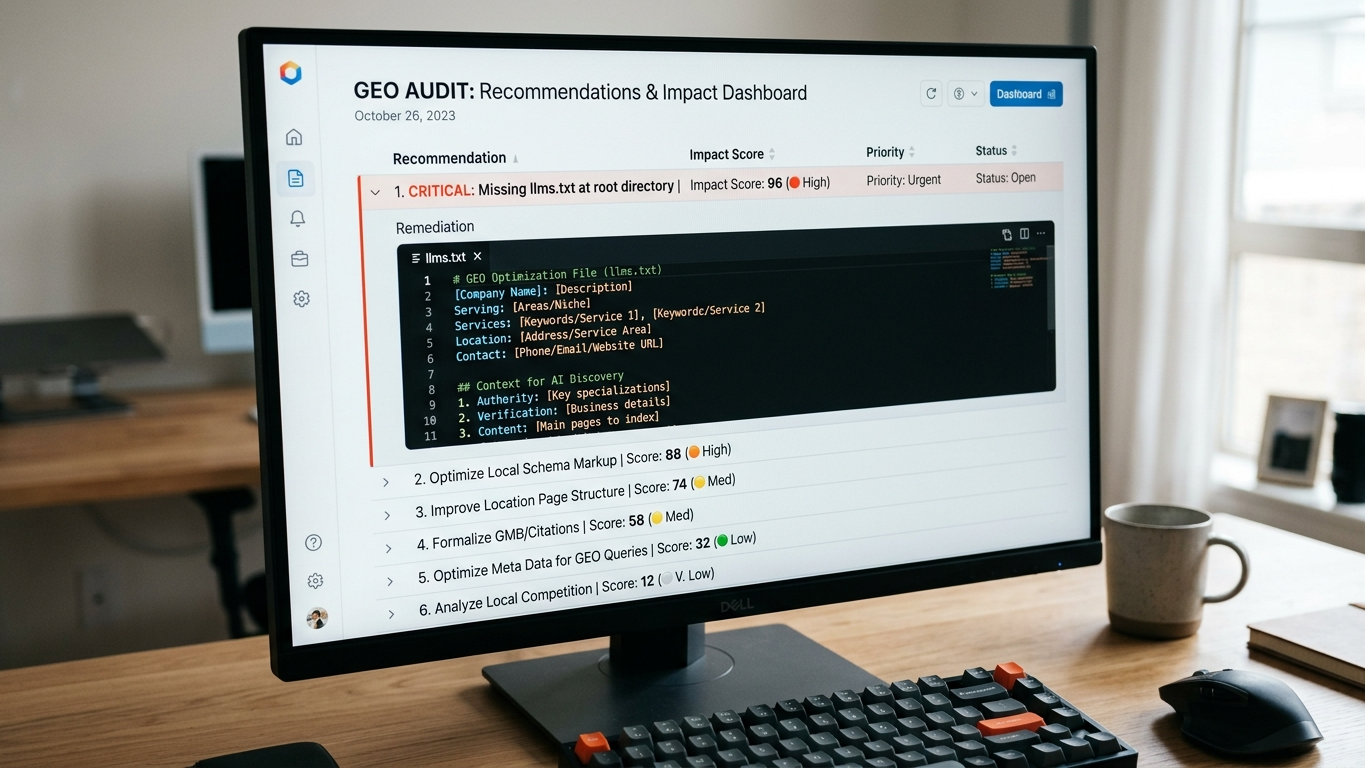
Live queries tell you where you stand. But to improve your position, your technical foundation must be in order. Think of a properly configured llms.txt file that explicitly tells AI crawlers which content they may index. Think of structured data that translates your expertise into a language models understand.
These technical elements are not an end in themselves. They are the prerequisite for increasing your citability.
Without live queries, however, you never know whether those technical adjustments actually have an effect. The combination of technical optimization and real-time measurement forms the core of an effective GEO strategy.
Why one-time testing is not enough
AI models are continuously updated. The sources ChatGPT cites today can be replaced tomorrow. A competitor who was invisible last month could become the primary recommendation next week. This is why GEO is not a one-time action, but a continuous process of trend tracking.
Quarterly reports show you how your GEO Score develops. Is your visibility increasing after optimizations? Are you losing ground due to an AI model update? Without regular measurements with industry-relevant queries, you miss these shifts.
The introductory price for the In-depth Scan (€149 excl. VAT, valid until September 30, 2026) gives you a cost-effective starting point to initiate this transition. No account needed, no setup, no API keys. You enter your domain and receive your action plan within 10 minutes.
Three steps to measurable AI visibility
The threshold to start has been deliberately kept low:
- Activate your scan. Enter your domain at growthscope.io and select the scan that fits your needs.
- GrowthScope analyzes. We run live LLM-queries on ChatGPT, Perplexity, Google AI Overviews, and Claude with questions that align with your industry.
- Receive your action plan. You get a GEO Readiness Score, an executive summary, and directly applicable recommendations to strengthen your visibility.
Don't wait until your competitor claims the AI answer
The shift from search results to AI syntheses is not a future scenario. It's happening now. Every day you don't measure is a day your competitor can claim the answer.
Discover today how AI engines report about your brand. Start your audit and gain control of your position in the new search economy. Have questions about the possibilities? Get in touch directly with our team.