Your content can be strong in substance, but if the structure is shaky, AI engines won't understand what you have to say. The heading hierarchy of your pages is the compass by which ChatGPT, Perplexity, and Google AI Overviews determine whether your brand is worth citing. In this tutorial, you'll learn step by step how to analyze, optimize, and deploy your heading structure as a strategic weapon for Generative Engine Optimization (GEO).
Why heading hierarchy is the foundation of your GEO strategy
AI models don't read your page the way humans do. They scan the structure to determine which information is most relevant to a user's question. Headings (H1 through H6) function as a table of contents that captures the hierarchy of your message.
A messy heading structure leads to low citability. In concrete terms: AI engines skip over your content and mention your competitor instead.
A clear hierarchy increases your GEO Readiness Score and makes your text literally "citable" for AI.
Step 1: Audit your current heading structure
Before you optimize, you need to know where you stand. Open the source code of a page or use your browser's inspection feature. Answer these three questions:
- Does the page have exactly one H1 that summarizes the main topic?
- Do the subheadings follow a logical sequence (H2 > H3 > H4) without skipping levels?
- Do the headings contain search intent, or are they vague labels like "More information"?
Note every deviation. This is your starting point. A faster route is to have a GrowthScope audit performed, which automatically analyzes your content structure and reports deviations per page.
Step 2: Understand the ideal hierarchy for AI engines
A correct heading hierarchy follows one principle: every heading promises, the text below delivers. AI engines use this structure to select fragments for their answers. The ideal structure looks like this:
| Heading level | Function | Example |
|---|---|---|
| H1 | Main topic of the page | Installing solar panels: costs and returns |
| H2 | Subtopics or main questions | What do solar panels cost in 2025? |
| H3 | Specifications within a subtopic | Price differences between mono- and polycrystalline |
| H4 | Detail information or nuances | Subsidies per region |
Never skip a level. An H4 directly under an H2 breaks the logic and makes it impossible for AI to understand the relationship between your information.
Step 3: Optimize your headings for citability
Now that you understand the structure, it's time to rewrite your headings so AI engines can adopt them as answer fragments. Use these three rules:
Formulate headings as questions or direct answers
AI engines match user questions to your headings. A heading like "Our approach" says nothing. A heading like "How does our installation method work?" directly aligns with a search query. Rewrite every vague heading to a formulation that answers a search question.
Incorporate your key message in the first sentence after the heading
The fragment that AI cites almost always consists of the heading plus the first one or two sentences below it. Place your most important fact or conclusion immediately after the heading. Save nuances for the rest of the paragraph.
Use semantically related terms in your H2's and H3's
Don't repeat the same keyword over and over. Use synonyms and related concepts that broaden the context. This helps AI models connect your page to a wider range of questions.
Step 4: Validate impact with content structure analysis
Optimization without measurement is guesswork. After implementing your changes, you want to know if your heading hierarchy actually scores better with AI engines.
With the GrowthScope Deep Scan, you can see per page how your content structure performs on 25 industry-relevant queries. You receive a GEO Score from 0 to 100 that indicates the extent to which your structure meets the requirements of ChatGPT, Perplexity, Google AI Overviews, and Claude. This makes the impact of your heading optimization directly measurable.
Common mistakes in heading hierarchy
Even experienced marketers and developers fall into these pitfalls:
- Multiple H1's on one page. Every page has one main topic. Multiple H1's confuse AI about your core message.
- Using headings for styling. Choosing an H3 because you like the font, rather than because of logical structure. Use CSS for formatting, headings for hierarchy.
- Headings that are too long. Keep headings under 70 characters. AI engines truncate longer headings and lose context.
- No headings in long text. A 500-word paragraph without a subheading is a wall. AI doesn't scan it, readers drop off.
How heading hierarchy works with other GEO factors
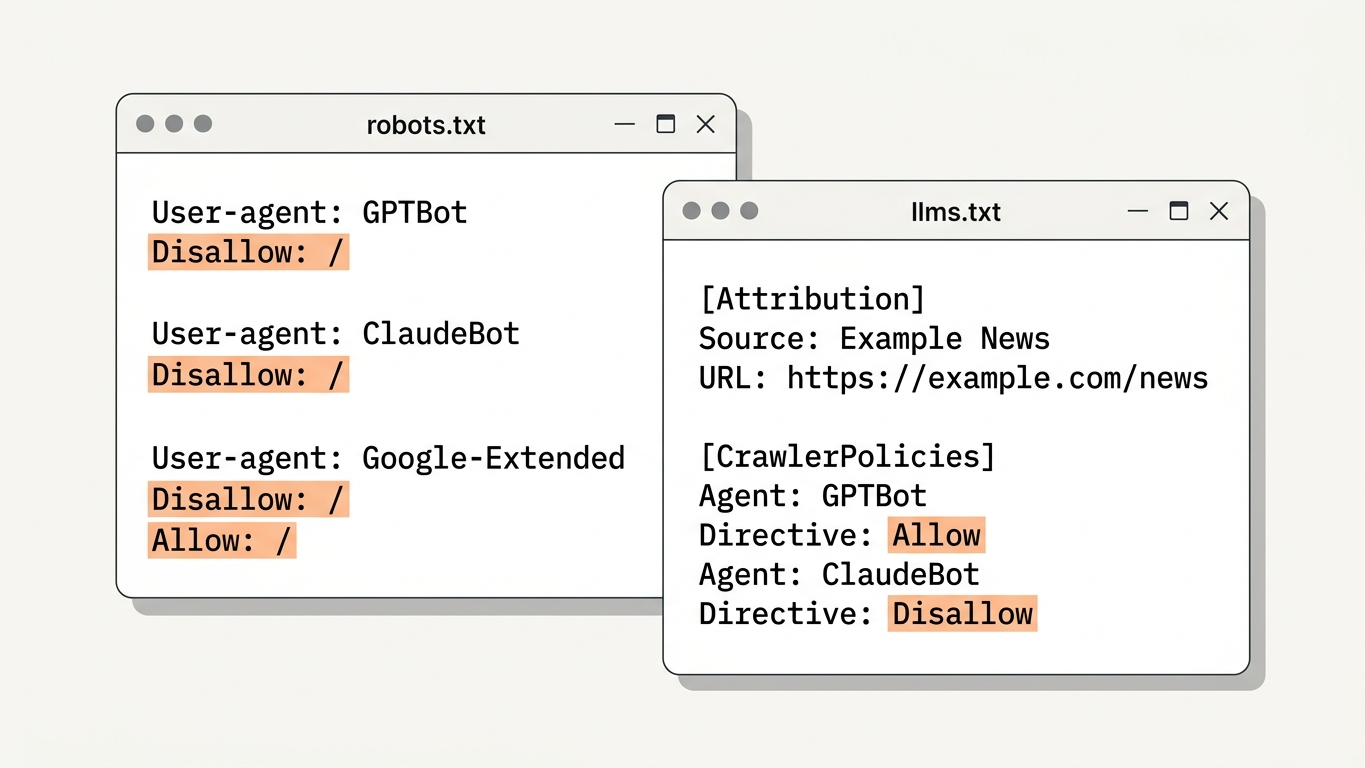
A correct heading structure doesn't stand alone. It reinforces other technical GEO elements that together determine your visibility. Think of schema markup that translates your content into a language AI understands, and a well-configured llms.txt file that gives AI crawlers permission to index your structured content.
Without the right headings, schema markup has less effect. The combination of these elements determines whether you get cited or ignored.
Your next step: from structure to strategy
A strong heading hierarchy is not a one-time action. Every new page, every new blog post deserves the same structural discipline. By regularly analyzing your content structure with quarterly reports, you maintain control over your position in AI answers.
Start today. Enter your domain on GrowthScope and receive a complete overview of your heading hierarchy, citability, and GEO Score within 10 minutes. No account needed, no setup, instant results.
Have questions about your content structure or want to discuss your GEO strategy? Get in touch and receive personalized advice.