Your marketing team publishes content daily. But who monitors how AI interprets and retells that content? In an era where ChatGPT, Perplexity and Google AI Overviews synthesize your brand story into bite-sized answers, content governance is no longer a luxury.
In an era where ChatGPT, Perplexity and Google AI Overviews synthesize your brand story into bite-sized answers, content governance is a strategic necessity.
Why content governance changes through generative AI
Traditional content governance revolved around publication rights, tone of voice and brand guidelines. Those rules still apply. But a fundamental shift is underway. AI engines cite your content without you having control over the context.
Concretely, this means: if your website contains contradictory information about prices, services or USPs, an AI model will pick up on that inconsistency. The result? A confusing or even incorrect AI answer that puts your competitors in a more favorable light. Generative Engine Optimization (GEO) therefore requires a new type of content governance that specifically accounts for how AI represents your brand.
The three pillars of AI-ready content governance
An effective governance framework for the AI era rests on three pillars. Each component addresses a specific risk that arises when AI models process your content.
1. Consistency as foundation
AI engines combine information from multiple pages on your website. One contradiction can undermine your credibility. Ensure that core messages, product descriptions and company information are identical on every page.
Practical steps for consistency:
- Create a central source document with approved brand facts and key figures
- Audit all pages quarterly for outdated or conflicting information
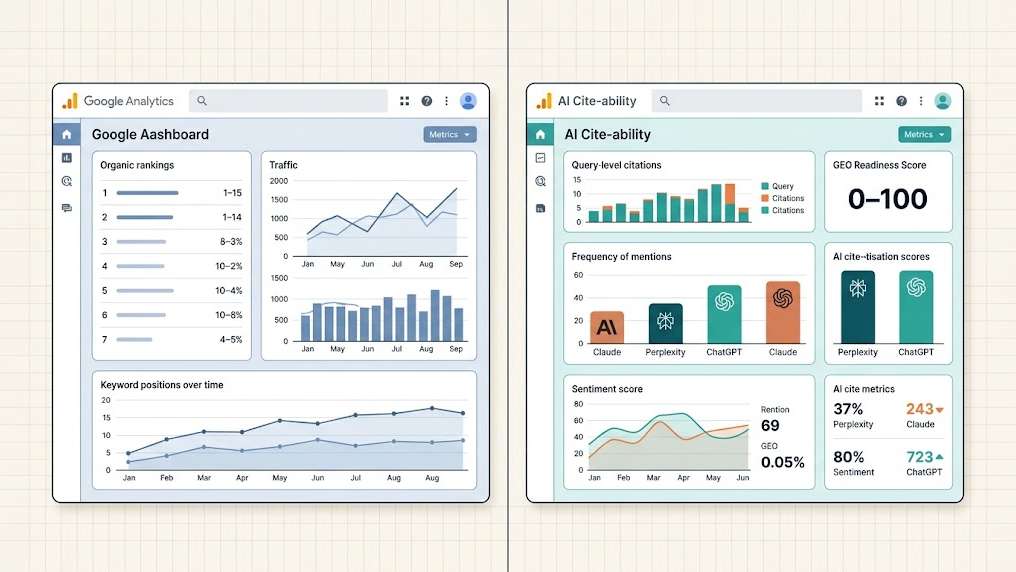
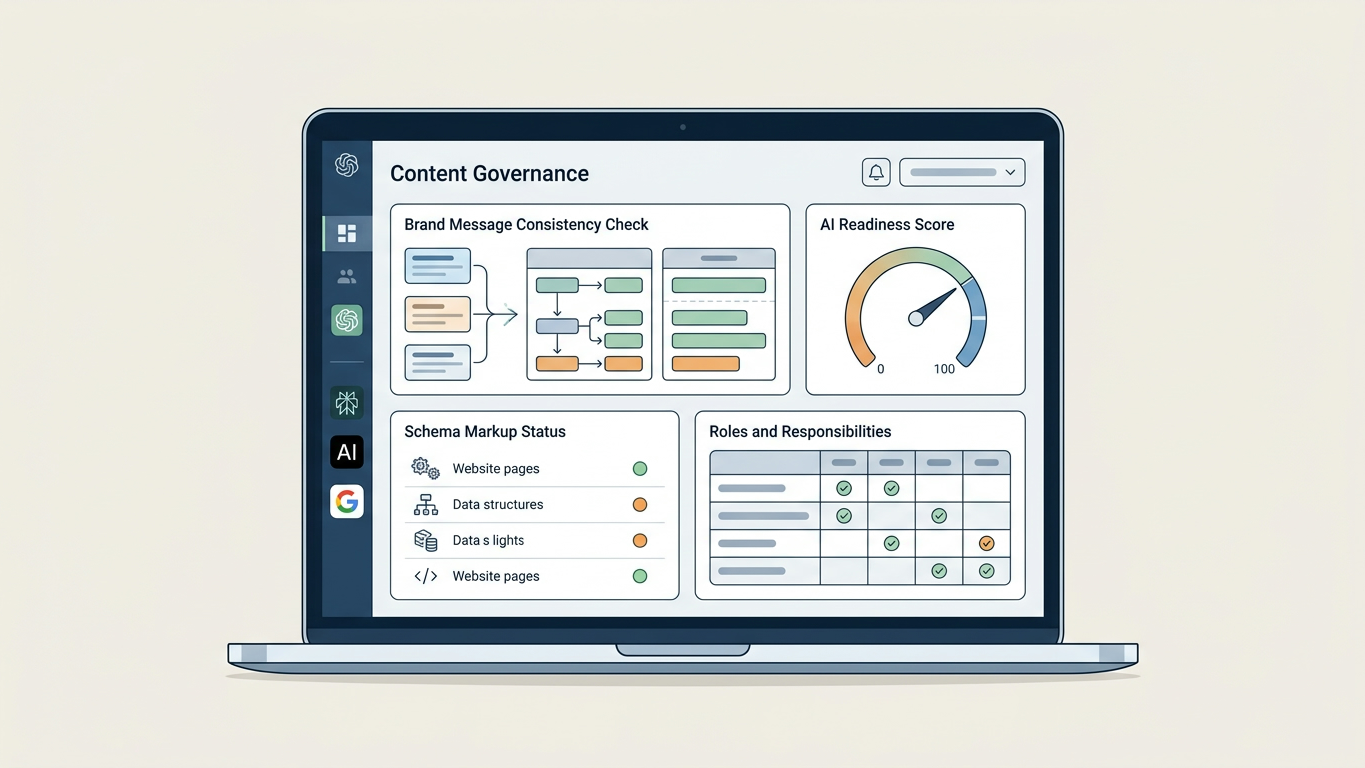
- Use your GEO Readiness Score as a measure of your content's citability
2. Structure for machine readability
AI models understand structured content better than standalone text blocks. Schema markup, clear heading structures and a logical information layer make the difference between being cited or not.
A crucial but often overlooked component is the llms.txt file. This file gives AI crawlers explicit instructions about which content they may index. Without this file, you leave the interpretation entirely to the algorithm.
3. Ownership and accountability
Who is responsible for AI representation of your brand? In many organizations, this falls between marketing, IT and communications. Appoint one owner who monitors the GEO strategy and reports to the management team.
| Role | Responsibility | Frequency |
|---|---|---|
| Content owner | Consistency of brand messages | Ongoing |
| Developer | Technical implementation (schema, llms.txt) | Per release |
| Marketing manager | GEO Score monitoring and stakeholder reporting | Quarterly |
| Management | Strategic prioritization and budget allocation | Half-yearly |
How do you measure the effectiveness of your governance?
Governance without measurability is merely an intention. The GEO Readiness Score (0-100) provides you with a quantifiable indicator of how well your content performs in AI answers. This score combines citability, structure and platform coverage into one clear number.
With the Deep Scan, you analyze 25 industry-relevant queries across four AI platforms: ChatGPT, Perplexity, Google AI Overviews and Claude. The result is not just a score, but an action plan with priorities. This translates governance policy directly into measurable progress.
The executive summary in each report enables you to present results to stakeholders without having to explain technical details. That is precisely the translation marketing managers need.
Five directly applicable governance actions
You don't need to wait for a complete organizational transformation. Start today with these five actions:
- Inventory contradictions. Go through your top-20 pages for conflicting information about services, prices and USPs.
- Implement llms.txt. Give AI crawlers explicit instructions. Your developer can implement this within an hour.
- Conduct a baseline measurement. Start a GEO audit to quantify your current position in AI answers. No account needed, no setup.
- Appoint a GEO owner. Make one person responsible for AI representation of your brand.
- Schedule quarterly reviews. AI models are continuously updated. Your governance must keep pace through structured trend tracking.
Competitive advantage through proactive governance
When your competitor offers a well-structured, consistent and citable brand story, the AI model chooses them. Not out of preference, but because their content is simply processed better.
Organizations investing now in a GEO-focused governance approach build a lead that is difficult to catch up on. With the current introductory price (valid until September 30, 2026), now is the time to start this transition cost-effectively.
The next step: from policy to results
Content governance doesn't have to be complex. The essence is simple: ensure your content is consistent, structured and citable for AI engines. Measure the results. Adjust where needed.
Discover how AI engines represent your brand today. Start your GEO audit and receive your personalized action plan within 10 minutes. Without API keys, without setup, immediate results.
Have questions about your GEO strategy? Contact our team for personal advice.