Calculating the ROI of Generative Engine Optimization: how to measure your AI visibility returns
Why the ROI of generative engine optimization must be measurable now
Marketing without measurable results is not a strategy. It is gambling. Yet more and more organizations are investing in generative engine optimization (GEO) without a clear picture of returns.
Traditional SEO metrics such as click-through rates and rankings don't tell the full story in a world where AI engines provide direct answers.
As a Marketing Manager, you are responsible for budget allocation that produces results. You must be able to explain to the management team why GEO is an investment and not a cost center. That starts with calculating ROI in a way that aligns with the new reality of AI visibility.
The problem: traditional metrics miss the AI layer
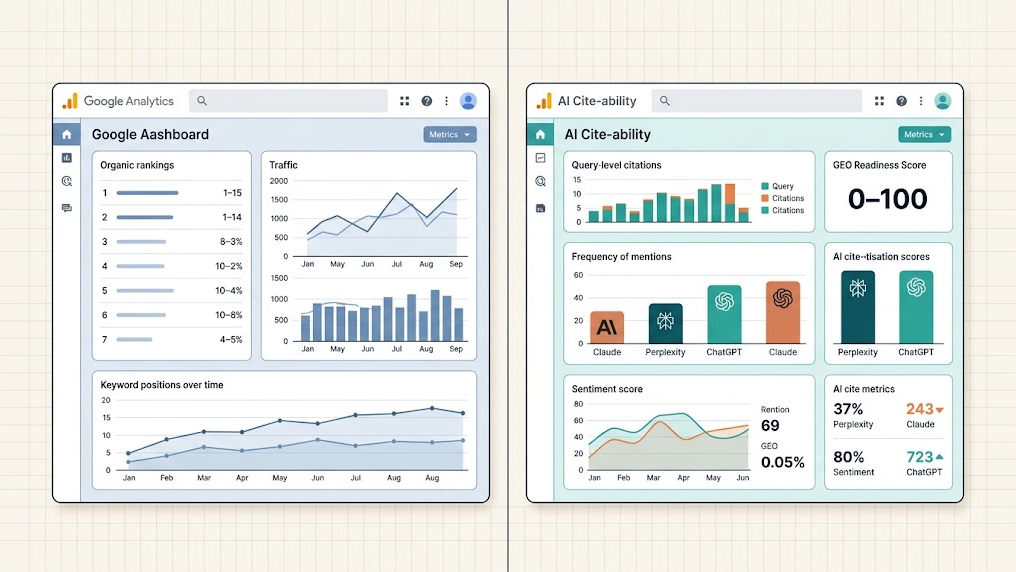
Google Analytics shows you website traffic. Your SEO tool displays rankings. But neither tells you whether ChatGPT, Perplexity, or Google AI Overviews recommend your brand when a potential customer asks a question. This is the blind spot problem that marketers are facing now.
In practice, this means: your competitor is mentioned in an AI answer, and you are not. The prospect doesn't even click through to a search result. There is no click to measure, no impression to count. Yet a conversion has been lost.
The GEO Readiness Score solves this by quantifying your visibility per AI platform on a scale of 0 to 100. That is your starting point for a solid ROI calculation.
Step 1: map your current AI visibility
Before you can calculate returns, you need a baseline measurement. Without a baseline, any improvement is anecdotal. The Deep Scan analyzes 25 industry-relevant queries across four platforms: ChatGPT, Perplexity, Google AI Overviews, and Claude.
With this data you know exactly:
- How many queries mention your brand
- Which platforms you are invisible on
- How your competitor scores compared to you
This is not an abstract technical exercise. This is the foundation of your business case.
Step 2: link AI visibility to commercial value
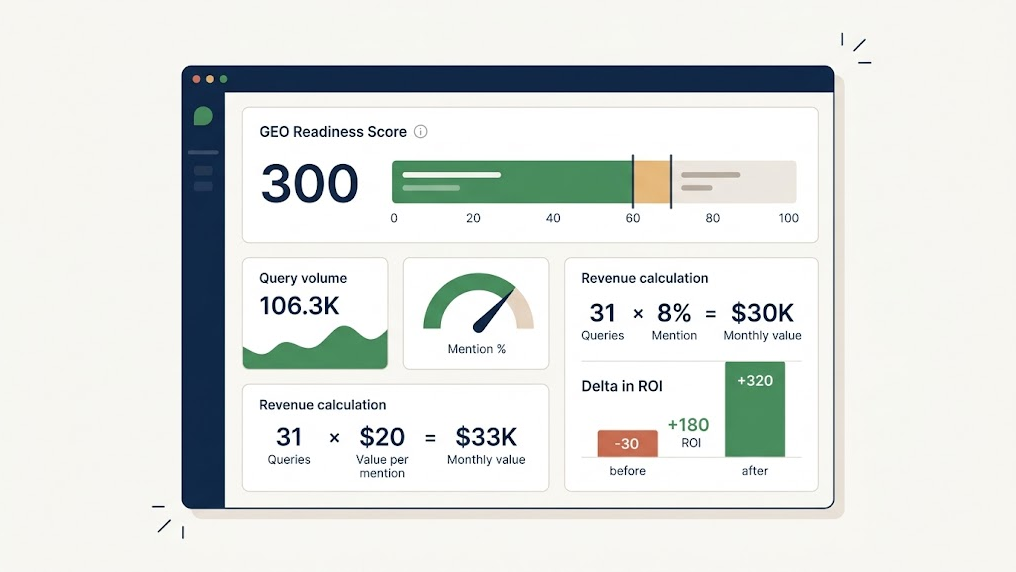
The core of every ROI calculation is simple: what does it deliver versus what does it cost? For GEO, you translate this into three concrete variables.
| Variable | Description | Example |
|---|---|---|
| Query volume | Number of times relevant questions are asked to AI | 5,000 per month |
| Mention percentage | Percentage of queries in which your brand appears | 12% (current score) |
| Conversion value per mention | Estimated revenue value of an AI mention | €8.50 per mention |
With these variables, you calculate your monthly GEO value: 5,000 x 12% x €8.50 = €5,100. Your mention percentage increases to 30% after optimization? Then that value grows to €12,750 per month. The difference, €7,650, is the direct return on your GEO investment.
Step 3: calculate the payback period of your GEO audit
A Deep Scan costs €149 excl. VAT and delivers a complete action plan with expected impact scores. Compare that to the potential monthly revenue you are losing through invisibility in AI answers.
The calculation for your management report:
- Investment: €149 for the audit plus implementation time
- Return: Measurable increase in AI mentions within the first quarter
- Payback period: In most cases less than 30 days
The management summary in your GEO report presents these figures ready-made. You only need to share them with your stakeholders.
Why quarterly trend tracking protects your competitive advantage
A one-time measurement is valuable. But AI models are continuously updated. What delivers a strong score today can shift next month. That is why structured trend tracking is essential for sustained returns.
By measuring your GEO Score each quarter, you build a trend line that gives you three things:
- Proof that your optimizations are working
- Early signal when competitors gain ground
- Data-driven justification for additional marketing budget
GEO is not a project with an end date. It is an ongoing process, similar to how you have been monitoring SEO for years.
The hidden ROI: brand reputation in AI answers
Beyond direct conversion value, there is a second layer of returns that is often overlooked. AI engines don't just answer questions, they form opinions. The tone in which your brand is described in an AI synthesis determines how prospects perceive you before they even visit your website.
A negative or missing mention costs more than a missed click. It damages your brand perception at scale. With the Sentiment Analysis module, you discover how AI reports on your organization and make adjustments where needed.
Technical optimizations that directly increase ROI
Your GEO report contains concrete technical recommendations. Two of them have the fastest impact on your mention percentage:
- llms.txt configuration: This file tells AI crawlers which content they are allowed to index. Without this file, you may miss all AI visibility.
- Schema markup optimization: Structured data translates your website into a language that AI understands. The better the translation, the more often you are cited.
Both optimizations are delivered ready for developers in your action plan. Your technical team can get started immediately.
Start your ROI calculation today
The introductory price for the Deep Scan is valid through September 30, 2026. This is the time to start cost-effectively before market saturation drives up competitive pressure.
- Enter your domain at growthscope.io
- Receive your GEO Score including management summary within 15 minutes
- Present your business case with hard numbers to your stakeholders
No account needed. No setup. No API keys. Only the insight you need to prove that GEO delivers measurable returns.
Start your audit →