How to Build a GEO-Driven Content Calendar for 12 Months
Why a Traditional Content Calendar No Longer Suffices for AI Visibility
AI engines such as ChatGPT, Perplexity and Google AI Overviews increasingly determine which brand gets mentioned in answers. Your existing content planning is probably built around search volumes and seasonal peaks. But the rules of the game are changing.
A GEO-driven content calendar is not about rankings, but about citability.
The goal: ensure that AI models recognize, understand and use your content as a source. Without a structural plan, you miss quarter after quarter opportunities to be visible in AI answers.
Step 1: Map Your Current GEO Position
Before you start planning, you need to know where you stand. Start with a GEO Readiness audit to determine your current score (0-100) per platform. This immediately shows you on which AI engines you are already mentioned and where the blind spots are.
Use the results to prioritize your content calendar. Scoring low on ChatGPT but high on Google AI? Then you know where the first content effort should go. Start your audit without account or setup and receive your action plan within 10 minutes.
Step 2: Define Your Quarterly Themes Based on AI Queries
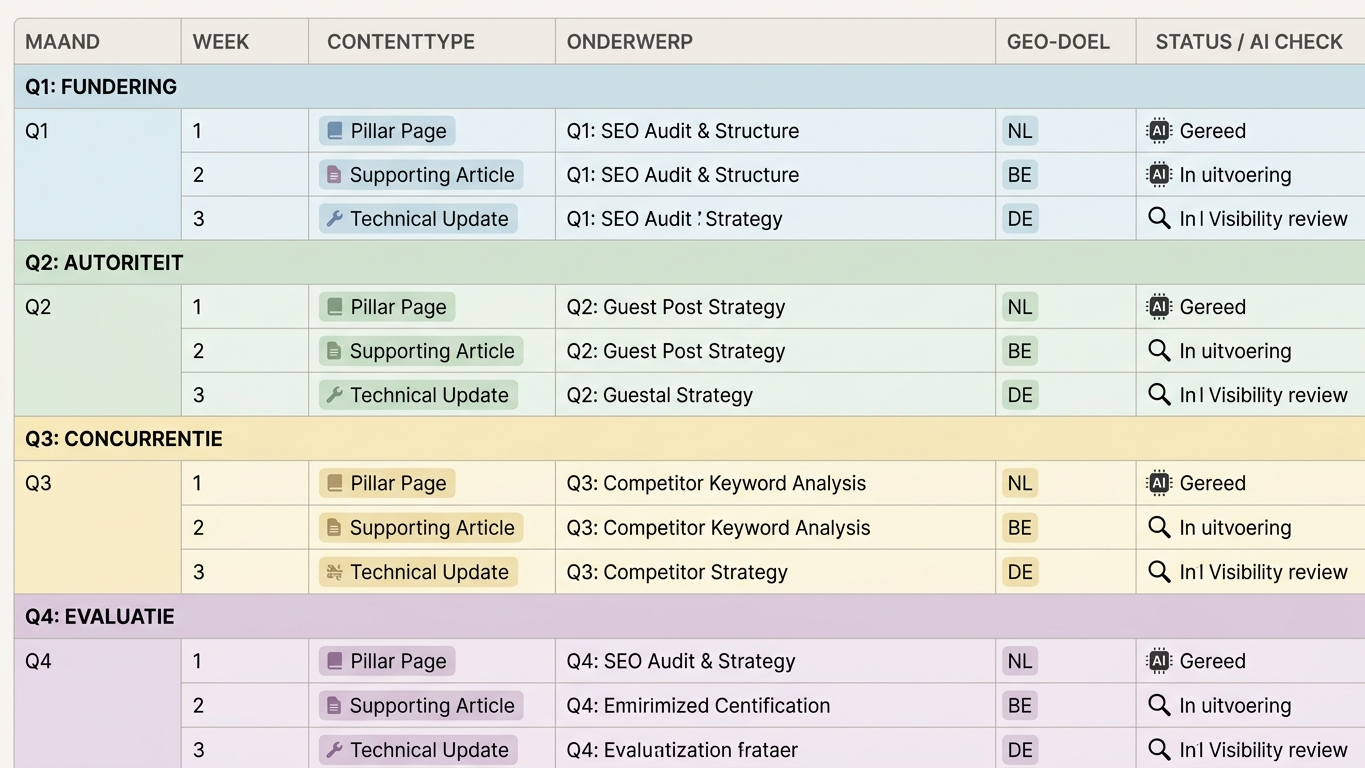
Divide your year into four quarters, each with a clear theme. This theme is not based on your own offering, but on the questions your target audience asks AI. Think from the prompt, not from the product.
Use this structure as a starting point:
| Quarter | Theme | Focus |
|---|---|---|
| Q1 | Foundation | Technical GEO optimization (schema markup, llms.txt, robots.txt) |
| Q2 | Authority | In-depth knowledge content and thought leadership |
| Q3 | Competition | Benchmarking and competitor-focused content |
| Q4 | Evaluation | Trend tracking, re-audit and strategy adjustment |
This structure ensures that you don't publish ad hoc, but systematically build algorithmic relevance.
Step 3: Plan the Right Content Types Monthly
Not every content type is equally citable for AI. Structure your monthly planning around formats that AI engines demonstrably prefer as a source.
Each month you plan at minimum:
- 1 pillar page: an extensive, structured page around a core question in your industry
- 2 supporting articles: specific sub-questions that link back to the pillar page
- 1 technical update: adjustments to llms.txt, schema markup or FAQ sections
This rhythm guarantees that you cover both the content and technical sides of GEO each month.
Monthly Template Example (Q1, January)
| Week | Content Type | Topic | GEO Goal |
|---|---|---|---|
| Week 1 | Technical update | Implement and test llms.txt | Crawlability for AI engines |
| Week 2 | Pillar page | Explain core process for target audience | Increase citability |
| Week 3 | Supporting article | Answer frequently asked questions from industry | Visibility on Perplexity and ChatGPT |
| Week 4 | Supporting article | Publish comparison or case study | Authority and sentiment building |
Step 4: Build in Measurement Moments Per Quarter
A content calendar without evaluation is a wish list. Plan a re-audit at the end of each quarter to re-measure your GEO Score. This immediately shows you what impact your content has had on your AI visibility.
With the quarterly subscription, you automate this trend tracking. You receive an updated report each quarter that shows improvement per platform. This makes it easy to adjust your calendar based on hard data rather than assumptions.
Evaluation Checklist Per Quarter
- Compare GEO Score with previous quarter
- Check per-page query mapping: which pages are being cited?
- Analyze competitive position: are competitors mentioned more or less often?
- Check sentiment: how does AI speak about your brand?
- Adjust content calendar based on results
Step 5: Translate Your Calendar into Team Responsibilities
A GEO content calendar touches multiple disciplines. Clearly distribute responsibilities across your team to ensure execution.
| Role | Responsibility |
|---|---|
| Content Marketer | Write pillar pages and supporting articles |
| Developer | Schema markup, llms.txt and technical GEO setup |
| SEO/GEO Consultant | Conduct quarterly audits, analyze trend tracking and adjust strategy |
| Decision Maker | Review GEO Score and make budget decisions |
By establishing this role division upfront, you prevent GEO optimization from remaining stuck with "someone should pick this up".
Your First Step: Know Where You Stand
A 12-month content calendar starts with a baseline measurement. Without insight into your current AI visibility, you plan in the dark. Measure your GEO Readiness Score today and use the results as the foundation for your first quarterly planning.
No account needed. No API keys. No setup. Start your GEO audit and receive your action plan within 10 minutes.