Word Count and Citability: Why LLMs Prefer 134-167 Words
The Ideal Length for AI Citations Is Shorter Than You Think
Imagine this: you invest months in a comprehensive knowledge article of 3,000 words. Yet ChatGPT cites your competitor with a concise answer of just 150 words. How is that possible? Recent analyses of AI responses reveal a striking pattern.
Large Language Models (LLMs) preferentially cite text fragments between 134 and 167 words. That narrow window determines whether your content appears as a source in AI responses, or is completely ignored.
For consultants shaping their clients' GEO strategy, this insight is essential. It shifts the focus from word count to algorithmic citability.
What AI Citability Research Reveals
The finding stems from systematic analyses of responses generated by ChatGPT, Perplexity, Google AI Overviews, and Claude. Researchers studied which sources were cited and what properties those sources shared. The result was remarkably clear.
Text blocks that were included as citations almost always fell within a bandwidth of 134 to 167 words. Shorter fragments lacked the context to serve as reliable sources. Longer blocks were summarized by the model or simply skipped in favor of more concise alternatives.
| Source Material Characteristic | Citable (134-167 words) | Non-Citable |
|---|---|---|
| Average passage length | 148 words | 300+ words |
| Structure | One clearly defined answer | Spread across multiple paragraphs |
| Factual density | High (figures, definitions) | Low (reflective, broad) |
| Likelihood of AI citation | Significantly higher | Minimal |
This doesn't mean long content is worthless. It means long content must be built modularly, with citable blocks of the right length.
Why This Word Range Works for LLMs
LLMs' preference for passages around 150 words is no accident. It relates to how these models process and return information.
Context window and relevance. LLMs assess passages for information density. A block of 150 words provides enough space to formulate a complete answer, including context, without noise. The model doesn't need to filter or summarize.
Pattern recognition. During LLM training, millions of passages were processed. Fragments that directly and completely answer a question predominantly fall within this range. The model has learned that this length correlates with reliability.
Output constraints. AI engines deliver compact answers to users. A source that is already compact requires less processing. That makes the source more attractive to the model than a passage that needs to be shortened first.
How to Optimize Content for the Ideal Citation Format
The translation to practice is concrete. You don't need to scrap your existing content. You need to restructure it so each core topic has a citable block.
Step 1: Identify Your Core Questions
Map out which specific questions your target audience asks per page. Use the per-page query mapping from your GEO audit to see which queries you already appear for, and where the gaps are.
Step 2: Write Citable Answer Blocks
For each core question, formulate a self-contained readable answer of 134 to 167 words. Place this directly under a descriptive H2 or H3 heading. Ensure high factual density: use figures, definitions, and concrete steps.
Step 3: Strengthen Technical Citability
A well-written block is only citable if AI crawlers can find it too. Check that your llms.txt file is correctly configured. Add schema markup so the structure of your answer blocks is machine-readable.
Step 4: Measure and Iterate
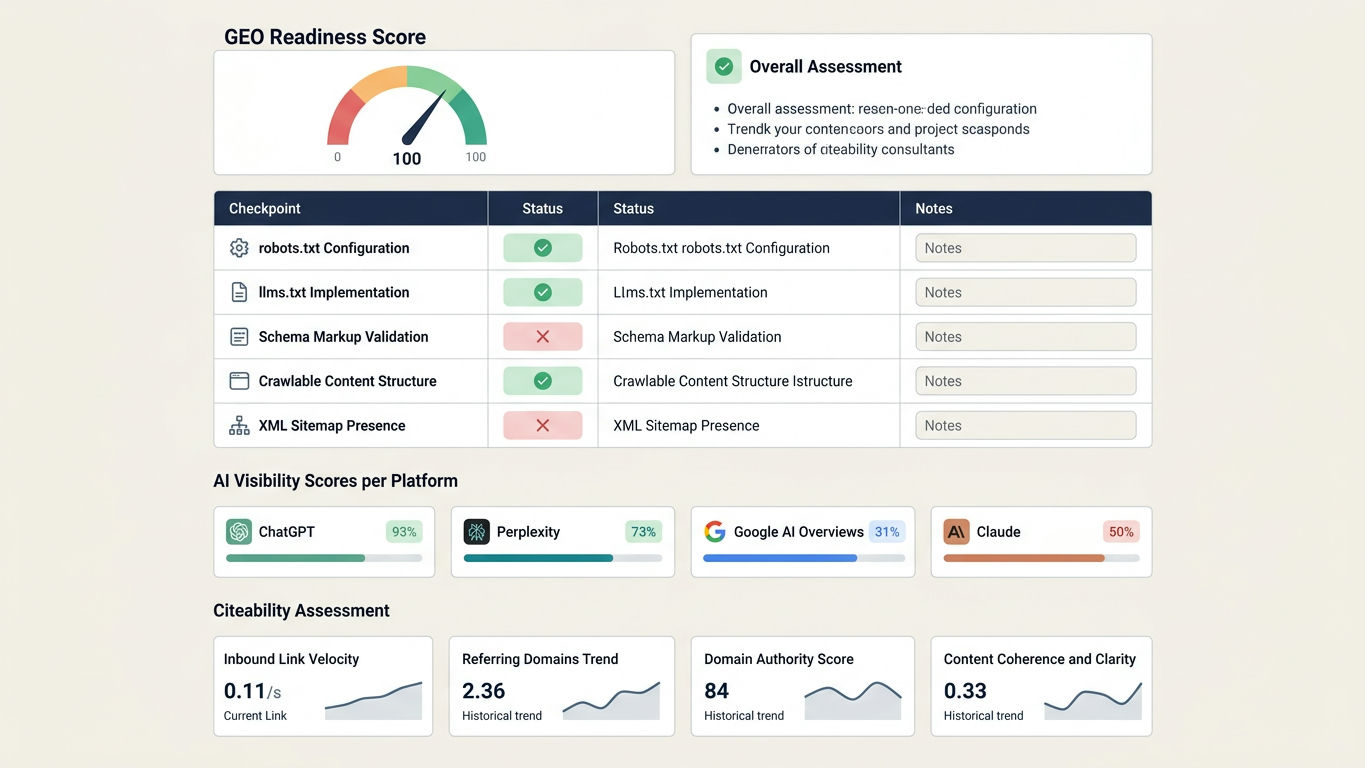
Citability is not a one-time action. By monitoring your GEO Readiness Score periodically through trend tracking, you'll see which blocks are actually being picked up. Adjust the blocks that underperform and scale the successful formats.
The Pitfall of Traditional Content Length
Many content strategies still optimize for total word count per page. "Write a minimum of 2,000 words for a top position." That logic comes from an era when Google rewarded long, exhaustive articles with higher rankings.
In the AI era, the metric shifts. A 2,000-word page without citable blocks scores worse in AI responses than an 800-word page with five sharply formulated answer blocks.
Total length matters less. The granularity of your content determines your AI visibility.
What This Means for Your GEO Strategy
This research confirms a broader trend: Generative Engine Optimization requires a fundamentally different approach to content creation. It's not about writing more, but about structuring smarter.
As a consultant, you can deploy this insight directly as evidence for your clients. The GEO Score demonstrates measurably which pages are citable and which are not. By tracking the score per quarter, you make the impact of your optimizations visible.
Start today. Perform a GEO audit on your client's domain and discover which pages already fall within the ideal citation window. Get directly applicable recommendations to increase the citability of each page, without an account, without setup.