You invest hours writing customer cases. Yet ChatGPT mentions your competitor when someone asks for a proven solution in your industry. That's because most case studies are written for human readers, not for the algorithms that generate AI answers.
AI engines like ChatGPT, Perplexity, and Google AI Overviews only cite content that is structured, specific, and rich in context. A vague testimonial saying "the customer was very satisfied" won't generate an AI mention. But a case study with concrete numbers, a clear problem, and a measurable result will.
This is the core of Generative Engine Optimization (GEO): structuring your content so AI models recognize it as a trustworthy source and cite it.
In this tutorial, you'll learn step by step how to write case studies that not only convince your prospects, but actually appear in AI answers.
The anatomy of an AI-citable case study
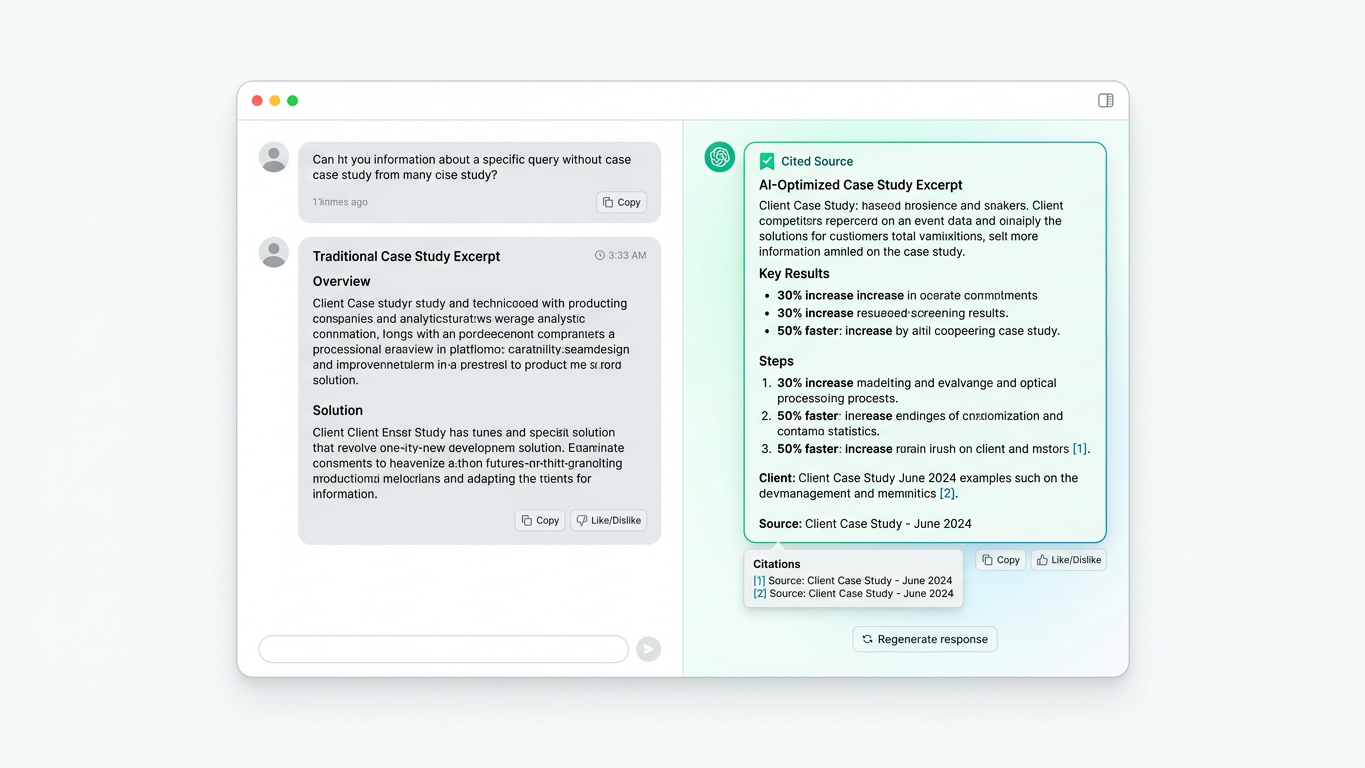
Not all case studies are equal. AI engines search for patterns that signal credibility. Below you'll see the difference between a traditional and an AI-optimized case study.
| Feature | Traditional case study | AI-optimized case study |
|---|---|---|
| Title | "Successful collaboration with customer X" | "40% more leads in 90 days for B2B software company" |
| Problem statement | Vague and general | Specific, with industry context |
| Results | "Significant improvement" | "Conversion rate rose from 2.1% to 3.4%" |
| Structure | Running text | Clear sections with schema markup |
| Source attribution | None | Numbers, timelines, and methodology |
AI models prefer content that presents facts over opinions. Your case study should function as a mini-research report, not a sales brochure.
Step 1: choose the right problem as your starting point
Don't start with your solution, but with your customer's problem. AI engines match user questions with answers that address the same problem. The more specifically you formulate the problem, the greater the chance of a match.
Ask yourself these three questions:
- What exact search query would someone with this problem ask?
- In what industry and company size does this problem occur?
- What alternatives did the customer consider before choosing you?
Wrong: "The customer was looking for a better marketing strategy."
Good: "A B2B SaaS company with 50 employees generated only 12 qualified leads per month through its website, despite a monthly marketing budget of €8,000."
That second formulation contains industry context, company size, and measurable data. Exactly the elements AI engines need to select your case as a relevant answer.
Step 2: structure your case study for maximum citability
Citability is the extent to which AI can literally adopt your texts as a source. This requires a predictable structure that AI crawlers can process seamlessly.
Always use these fixed sections:
- Situation: Who is the customer? What industry, size, challenge?
- Approach: What method or solution was implemented? Be concrete about steps and timeline.
- Result: What measurable outcomes were achieved? Use percentages, euros, or time periods.
- Conclusion: What lesson or insight is generalizable to other organizations?
This structure aligns with the "problem, solution, proof" pattern that AI models train to classify as trustworthy. Don't forget to check your technical GEO setup: without the right schema markup and crawl settings, even the best-written case won't reach AI engines.
Adding schema markup
Add Article or CaseStudy schema markup to each case study. This explicitly tells AI crawlers that this is a substantiated case. Combine this with a properly configured llms.txt file so AI models are actually allowed to index your case studies.
Step 3: write titles and summaries that trigger AI
The title of your case study is the first selection criterion for AI engines. A generic title like "Customer case company X" provides no context. AI needs specific signal words.
Use this formula for titles: [Measurable result] + [time period] + [industry or customer type]
Examples:
- "62% higher organic visibility in 6 months for e-commerce retailer"
- "From 3 to 18 AI mentions per quarter for financial advisory firm"
- "Bounce rate reduced from 71% to 34% for B2B service provider"
Always add a two to three-sentence summary below the title that makes the problem, approach, and result clear in one scan. This fragment is exactly what AI engines cite in their answers.
Step 4: measure whether your case studies are actually being cited
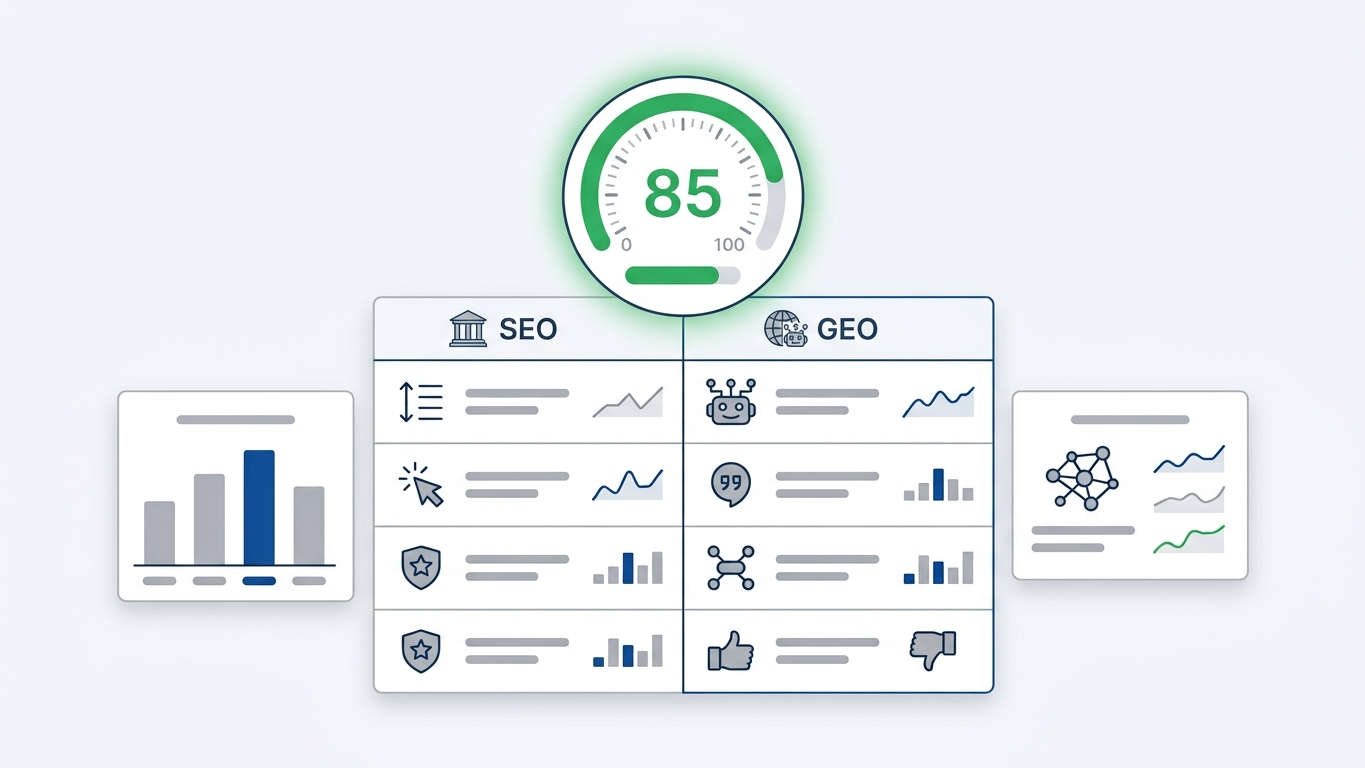
Writing is only half the work. Without measurement, you don't know if AI engines are picking up your cases. This is where your GEO Readiness Score comes in.
With a GEO audit, you discover per page:
- Whether your case study appears in answers from ChatGPT, Perplexity, Google AI Overviews, and Claude
- How your visibility compares to that of your competitors
- Which technical improvements will increase citability
Without this data, you're optimizing blind. The audit delivers a concrete action plan within 10 minutes, with no account or API keys required. This way you know exactly which case studies already work and which are still invisible.
Checklist: make your case study AI-proof
Use this checklist before publishing:
- Does the title contain a measurable result, time period, and industry?
- Is the problem specific enough to match a real search query?
- Are there at least three quantifiable results in the case?
- Are the sections (Situation, Approach, Result, Conclusion) clearly separated?
- Has schema markup been added to the page?
- Is the llms.txt file correctly configured?
- Have you run a GEO audit after publishing to measure visibility?
From invisible to cited: the next step
Case studies are the most powerful proof you can provide. But only if AI engines can find, understand, and cite them.
By structuring your cases according to the method above, you transform existing content into a continuous source of AI mentions.
Want to know if your current case studies are already visible in AI answers? Start your GEO audit today and receive your personal action plan within 10 minutes.
Do you have questions about your GEO strategy? Contact us and discover how you can stay ahead of your competitor in AI visibility.