You can publish the most valuable content in your industry. But if AI crawlers from OpenAI, Anthropic or Google cannot read your site correctly, that content simply does not exist in their answers.
The technical GEO setup is the foundation on which your entire AI visibility rests.
This is not a theoretical problem. Millions of search queries are answered daily by ChatGPT, Perplexity and Google AI Overviews. If your technical infrastructure is not in order, you miss every time a potential customer asks a relevant question. Your competitor who is technically ready gets the mention.
In this guide you will discover exactly which technical elements you need to validate, how to implement them and why a systematic approach structurally increases your GEO Readiness Score.
The three pillars of a technical GEO setup
A solid technical GEO setup rests on three essential pillars. Without even one of these elements, you lose grip on how AI engines interpret your site.
1. Crawlability: let AI bots in
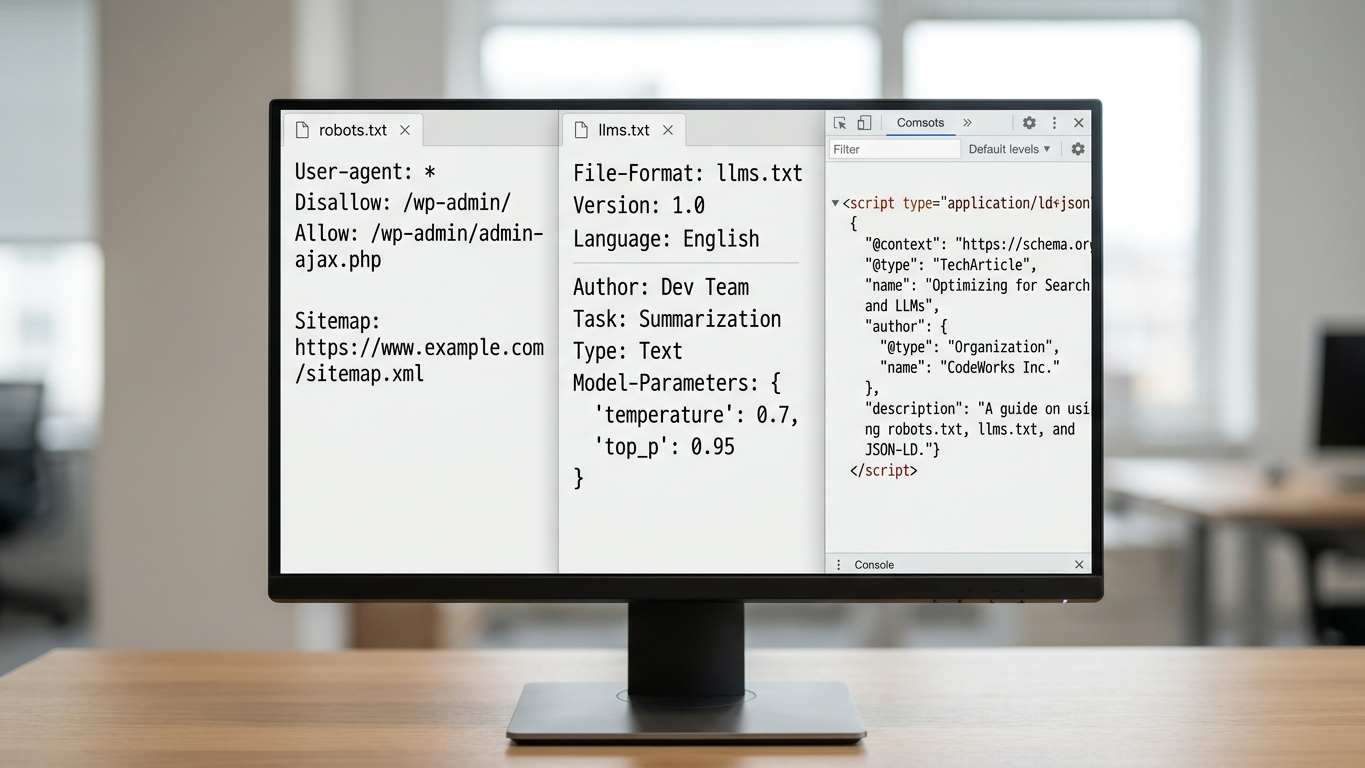
The first question is simple: are AI crawlers even allowed to see your content? Your robots.txt is the access gate. Many websites unintentionally block crawlers from OpenAI (GPTBot) or Anthropic (ClaudeBot) because their robots.txt is still configured for a world without generative AI.
Validate the following points immediately:
- Is GPTBot, ClaudeBot or PerplexityBot blocked in your
robots.txt? - Is your sitemap current and accessible to all relevant bots?
- Are important pages excluded by
noindextags that are no longer relevant?
A single incorrect line in your robots.txt can mean ChatGPT never mentions your brand. That is not an edge case, that is daily reality.
2. llms.txt: the new standard for AI communication
In addition to robots.txt, there is a new file specifically designed for AI engines: llms.txt. This file tells AI crawlers in structured form who you are, what you do and which content has priority.
Think of llms.txt as your business card for AI. Without this file, an AI engine must interpret what your site means itself. With this file you actively steer the narrative.| Component | Without llms.txt | With llms.txt |
|---|---|---|
| Brand identity | AI interprets itself | You define the context |
| Content priority | Random | You determine the hierarchy |
| Citability | Unpredictable | Structured and consistent |
Generating a correct llms.txt template does not have to take weeks. The GrowthScope Quickscan delivers a ready-to-use template within 2 to 5 minutes that you can implement directly.
3. Schema markup: translate your site to AI language
Schema markup is the translation of your website into a language that both search engines and AI engines understand. It goes beyond the classical SEO application. For GEO, schema markup determines how accurately AI can cite your products, services, reviews and expertise.
Check at least these schema types:
Organization: your company name, logo, contact informationProductorService: your core activities with descriptionsFAQ: frequently asked questions that AI can directly adopt as answersArticle: for blog content with author, publication date and subject
Missing or incorrect schema markup causes AI engines to be unable to structure your information. The result: your competitor with correct markup gets cited, you do not.
Server-side rendering: the invisible bottleneck
A technical point that is often overlooked is server-side rendering (SSR). Many modern websites use JavaScript frameworks that only load content after the page is opened in the browser. AI crawlers do not open a browser. They read raw HTML.
If your content depends on client-side rendering, an AI crawler sees an empty page. No content, no citation, no visibility. Validate that your most important pages render completely without JavaScript. This is one of the first checks the GrowthScope crawl automatically performs.
From baseline to structural improvement
The technical GEO setup is not a one-time project. AI engines update their crawlers, new standards like llms.txt are continuously developed and your own website changes constantly. Without regular validation, your technical foundation degrades unnoticed.
A pragmatic approach in three steps:
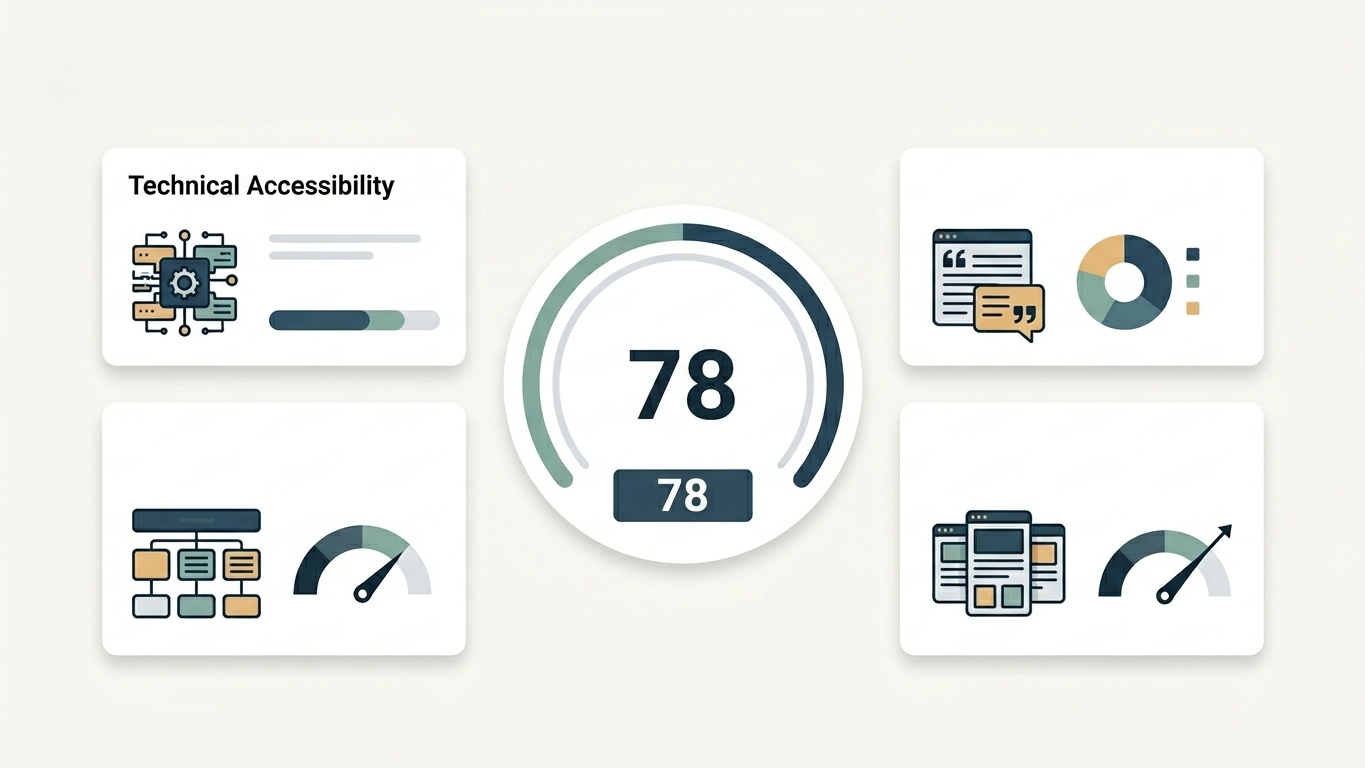
- Scan today: perform a Quickscan and receive your GEO Readiness Score from 0 to 100 within minutes
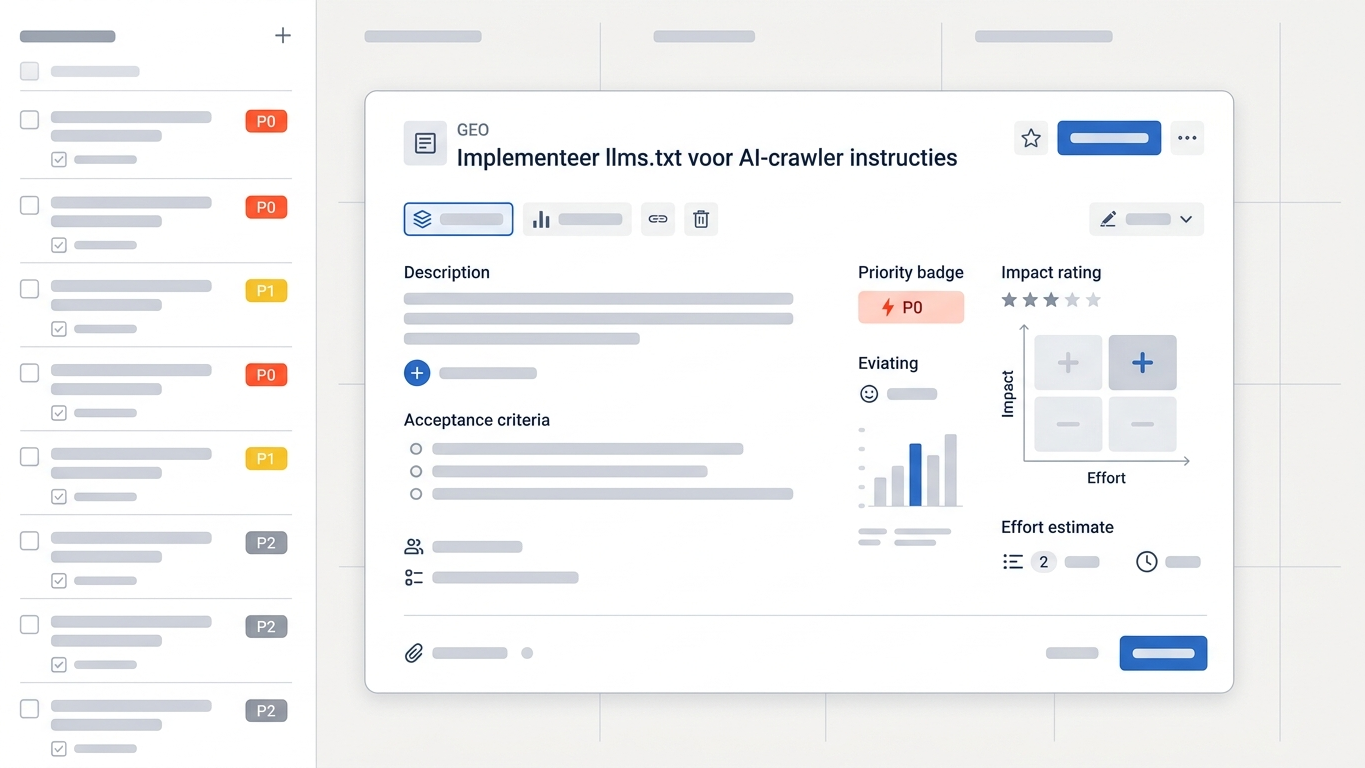
- Implement immediately: adjust your
robots.txt,llms.txtand schema markup based on the developer-ready action plan - Monitor structurally: schedule a quarterly trend track to detect degradation before it has impact
You integrate this cycle as Technical Health KPI in your monthly sprints. This way GEO becomes not a marketing project, but a technical standard within your development workflow.
The technical checklist for developers
Use this checklist as reference for every deployment or sprint review:
robots.txtallow for GPTBot, ClaudeBot and PerplexityBotllms.txtpresent in the root of your domain- Sitemap current and error-free
- Schema markup validated via structured data test
- Server-side rendering active for all critical pages
- Canonical tags correctly set to prevent duplicate content
- HTTPS active on all pages without mixed content warnings
Every checkbox you cannot tick is a potential reason why AI mentions your competitor instead of you.
Grip on your technical GEO foundation starts now
The technical GEO setup is not a luxury. It is the minimum requirement to participate at all in the AI era. Without correct crawlability, without llms.txt, without validated schema markup, your content remains invisible, regardless of quality.
Start your GrowthScope audit today and receive your technical baseline within minutes. No account required. No setup. No API keys. Just a domain and immediate insight.
Start audit →